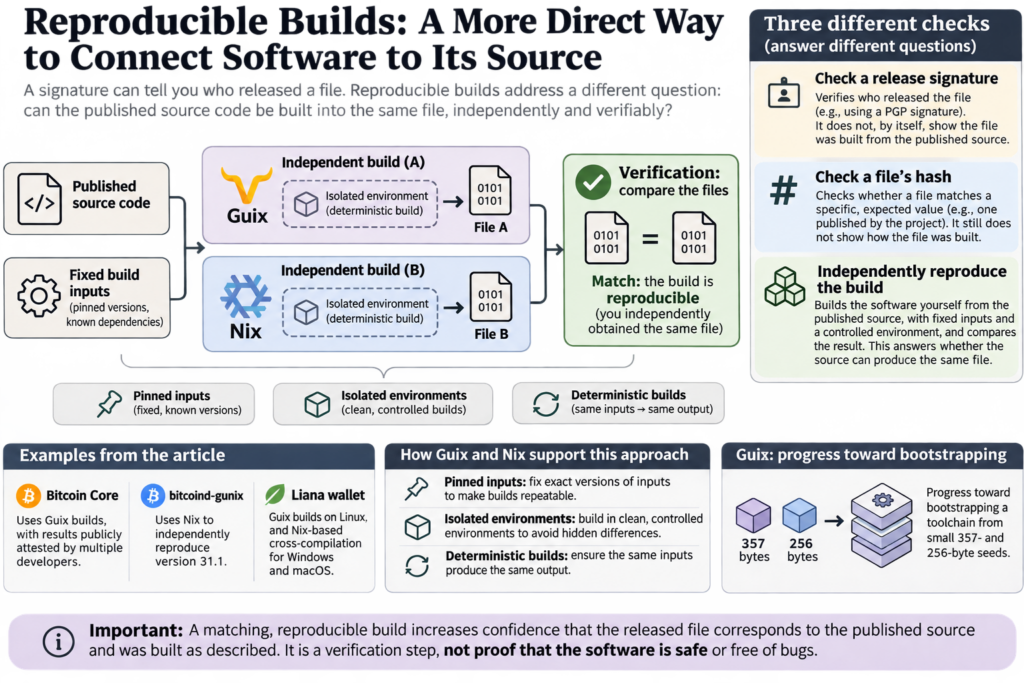
When you download wallet software, a signature can help you check who released the file. It cannot, by itself, show that the file was built from the published source code. Reproducible builds address that separate trust question: independent builders use fixed inputs and controlled environments, then compare the resulting files.
In an article published on November 13, 2026, the author described how Guix and Nix support this approach through pinned inputs, isolated environments and deterministic builds. The article also reviewed Guix’s progress toward bootstrapping a toolchain from small 357- and 256-byte seeds.
The examples included Bitcoin Core, which uses Guix builds with results publicly attested by multiple developers, and bitcoind-gunix, which uses Nix to independently reproduce version 31.1. For the Liana wallet, the article described Guix builds on Linux and Nix-based cross-compilation for Windows and macOS.
For a holder choosing software to rely on, the practical distinction is between checking a release signature, checking a file’s hash and independently reproducing the build. Each answers a different question; none should be mistaken for the others. The article discusses commands for those checks, but the supplied text does not include the commands themselves.