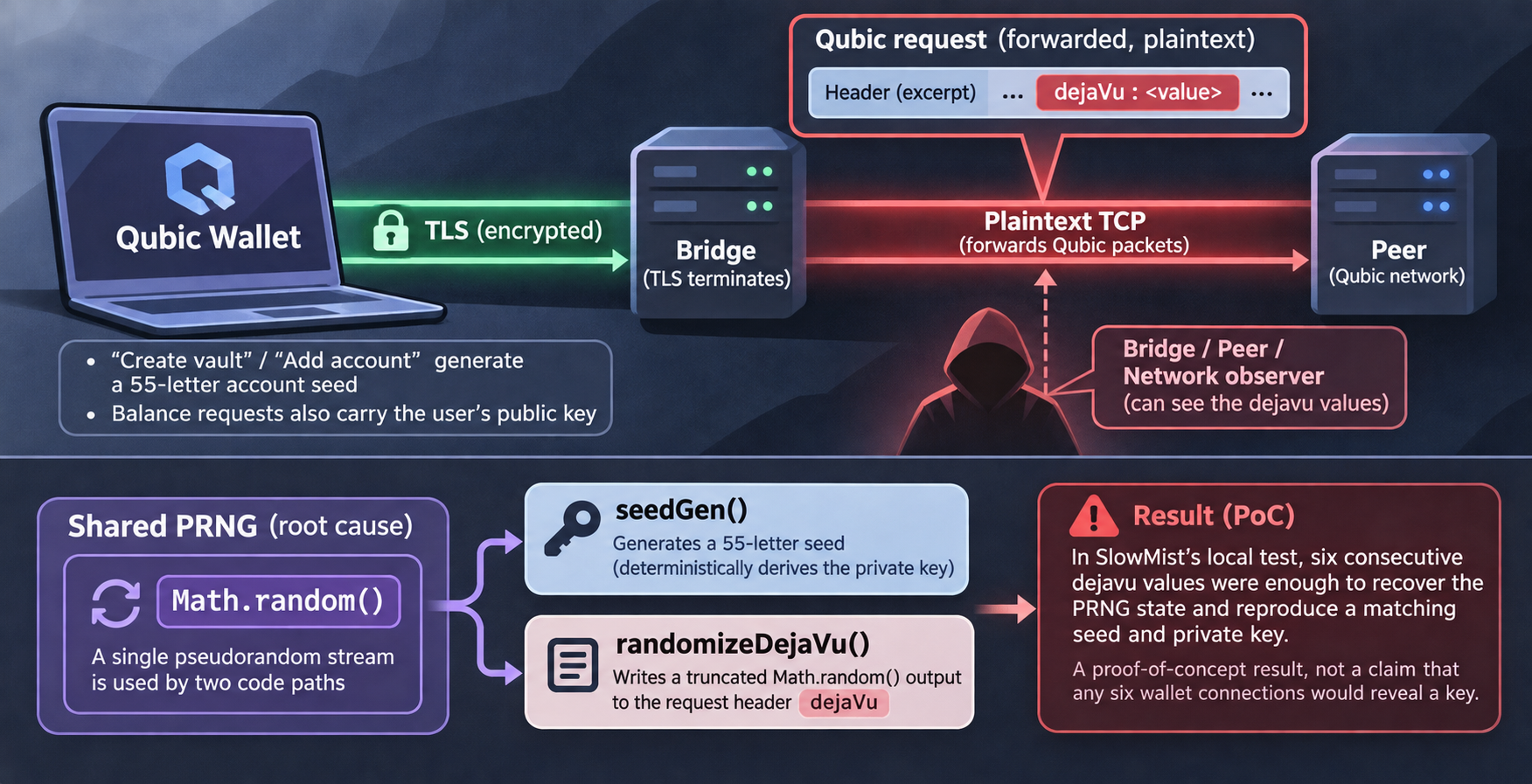
For anyone holding Qubic assets in a wallet created with the built-in seed generator, the concern is whether the account’s seed was predictable. A software update can change how new seeds are generated, but it does not change a seed that was already created.
In an analysis published on October 20, 2026, SlowMist examined a weakness in Qubic Wallet’s seed generation and its network requests. SlowMist said a Qubic announcement on October 18 reported that an attacker had accessed 1,404 Qubic wallets and transferred approximately 2.94 trillion QU. SlowMist’s local proof of concept demonstrated a way to reconstruct a private key; the report did not establish that this was the method used in the reported theft.
How the two code paths connected
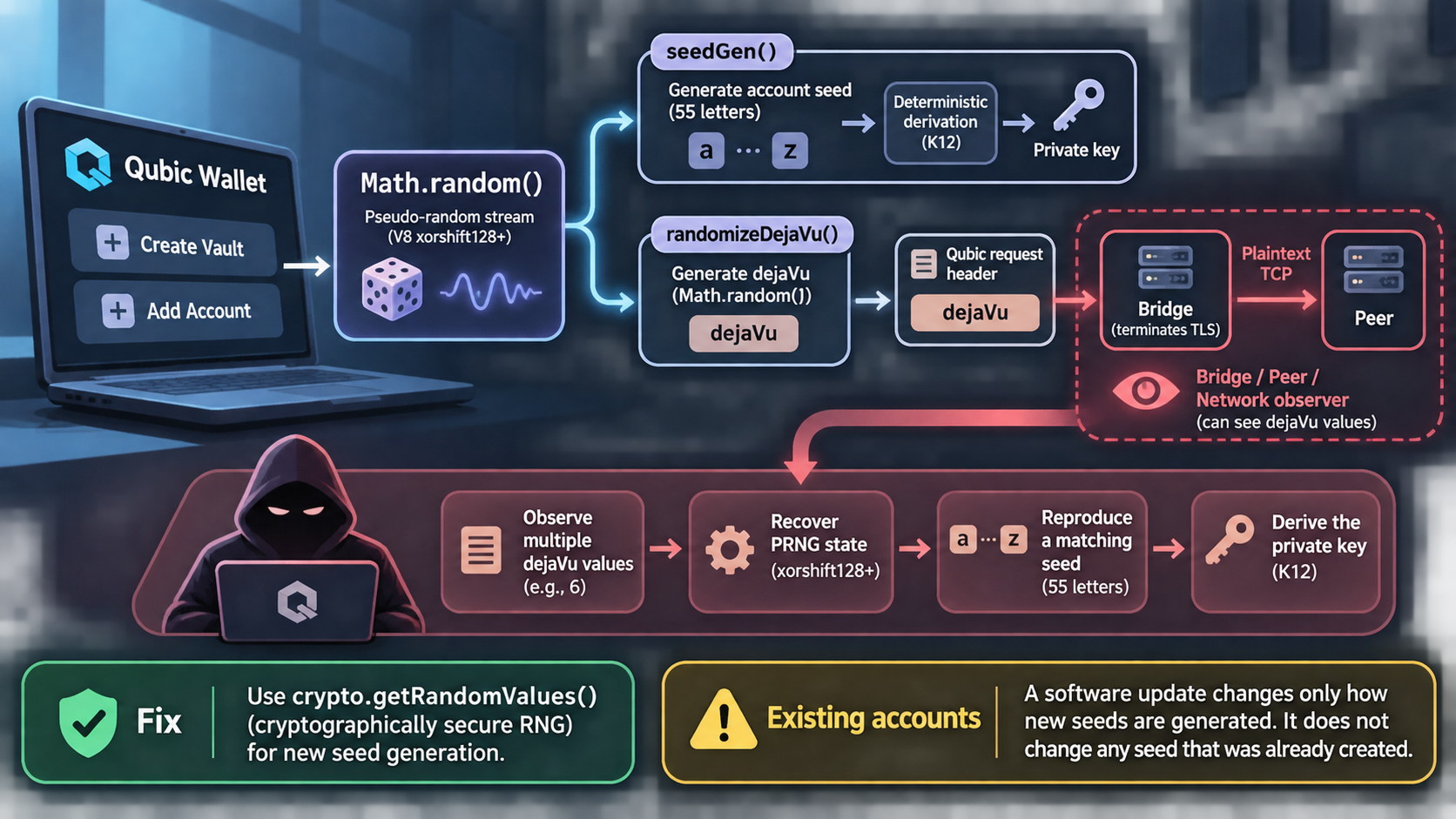
According to SlowMist, Qubic Wallet’s “create vault” and “add account” functions generated a 55-letter account seed using JavaScript’s Math.random(), rather than a cryptographically secure random-number generator. That seed deterministically produced the account’s private key. The derivation did not add a user password, device key or second random source.
SlowMist found that a library function, randomizeDejaVu(), also used Math.random(). It placed a truncated output in the dejaVu field of Qubic request headers. The wallet connected through a bridge that terminated TLS and forwarded Qubic packets to a peer over plaintext TCP. SlowMist said the bridge, the peer or an observer of that plaintext connection could therefore see samples from the same pseudorandom stream. Balance requests also carried the user’s public key, which could be used to check a candidate seed offline.
In SlowMist’s local test, six consecutive dejaVu values were enough to recover the modeled random-generator state and reproduce a matching seed and private key. That is a proof-of-concept result, not a claim that any six wallet connections would reveal a key. SlowMist said real-world success would depend on access to the relevant network traffic, the continuity and alignment of the observed values, and whether other code consumed random values between requests.
What the finding means for existing accounts
SlowMist listed the flaw as fixed by switching to crypto.getRandomValues(). The reported exposure concerned accounts created with the wallet’s built-in random seed generator; the source did not establish that every Qubic account was compromised. Holders assessing an existing account should distinguish a fix to future seed generation from the security of a seed generated earlier. SlowMist recommended external security audits and a systematic review of key generation, random-number sources and the trust boundaries around protocol-header fields.