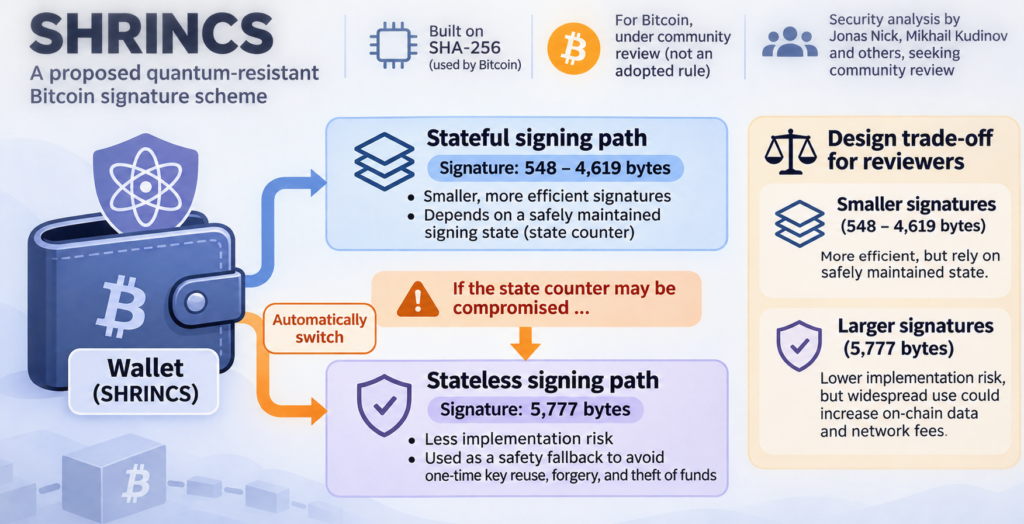
A wallet using a stateful signature scheme has to keep track of its signing state. If that state may be compromised, what happens next matters for the safety of the funds it holds.
In a November 20, 2026 report citing Decrypt, TechFlow said Blockstream research lead Jonas Nick, researcher Mikhail Kudinov and others had published a security analysis of SHRINCS, a proposed quantum-resistant Bitcoin signature scheme. The researchers were seeking community review of both the scheme and the analysis. The report did not describe SHRINCS as an adopted Bitcoin rule.
SHRINCS builds on SHA-256, which Bitcoin already uses. Its stateful signing path offers smaller signatures, listed at 548–4,619 bytes. Its stateless path has a larger, 5,777-byte signature but presents less implementation risk, according to the report.
Nick said a wallet must automatically switch to the stateless path when its state counter may be compromised. Otherwise, reusing a one-time key could allow a forged signature and theft of funds. He also cautioned that widespread use of stateless signatures could increase on-chain data and network fees. That leaves a design trade-off for reviewers: smaller signatures depend on safely maintained state, while the fallback uses more space.