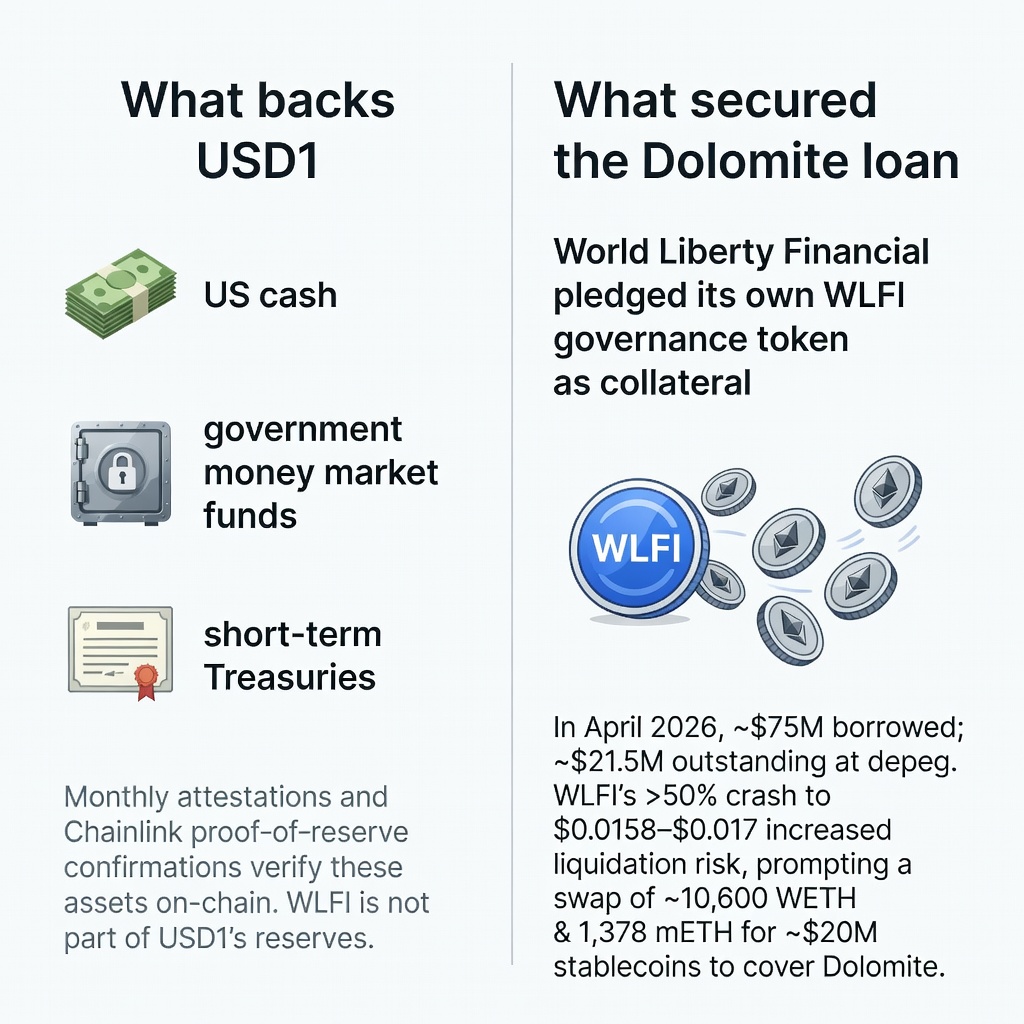
World Liberty Financial’s USD1 briefly traded at $0.94 on Binance on November 28, 2026, before recovering to about $0.99. For holders, the key distinction is what backed the stablecoin and what backed the project’s borrowing: World Liberty pledged its own WLFI governance token for a loan on Dolomite, but WLFI was not part of USD1’s reserves.
Redemptions continued as USD1 traded below a dollar
BitGo, USD1’s issuer and custodian, processed more than $110 million in USD1 redemptions on Ethereum in the 24 hours around the dip. Arbitrage trading, including activity by Jump Crypto, helped bring the exchange price back toward $1. In the month before the dip, USD1’s market capitalization had already fallen by approximately $1 billion to about $2.8 billion.
USD1’s reserves consist exclusively of US cash, government money market funds and short-term Treasuries. Monthly attestations cover those assets, and Chainlink proof-of-reserve confirmations are intended to let holders verify the backing on-chain. Neither check assesses World Liberty’s separate treasury decisions.
Why WLFI’s price mattered to the Dolomite loan
USD1’s drop followed a large withdrawal and other on-chain activity on Dolomite, a lending protocol. World Liberty had borrowed approximately $75 million in stablecoins there in April 2026, using WLFI as collateral. About $21.5 million remained outstanding when USD1 slipped below its peg.
WLFI fell more than 50% to a record low reported in the range of $0.0158 to $0.017. That decline reduced the value of the collateral securing the loan, increasing the risk of liquidation. A project-linked reserve wallet reportedly swapped about 10,600 WETH and 1,378 mETH for roughly $20 million in stablecoins in an effort to avoid liquidation. Most of those stablecoins reportedly went to Dolomite.
The outstanding debt left World Liberty exposed to further declines in WLFI: a lower collateral value raises liquidation risk, and a liquidation could put further pressure on the token’s price. For USD1 holders, that exposure is a reason to distinguish questions about World Liberty’s borrowing and BitGo’s oversight of the project’s treasury activity from the narrower question that reserve checks address: which assets back USD1.