Bitcoin’s June closing low of $58,525 survived a November 25 test: BTC traded below $58,000 after higher-than-expected US inflation data and fresh tariff threats, but finished the day above the June mark. By November 26, 2026, it was trading at $60,609, up 2.2% on the day. For holders trying to judge whether the bear market had ended, the distinction was important: the June low held on a closing basis, but few of the signals Galaxy associates with past bottoms were in place.
Why Galaxy changed its view
Galaxy had argued in October that the bear market ended in June. Its head of research, Alex Thorn, withdrew that assessment after Bitcoin fell back below its 50-week moving average. Galaxy now considers a daily close below $58,525, rather than a brief dip below it, a break of the June low. In all seven comparable breaks Galaxy identified in past bear markets, Bitcoin’s eventual low was at least 17% below the broken level. That was a historical pattern, not a forecast.
As of November 22, Bitcoin had met only two of Galaxy’s 13 bottom signals. One missing signal was a close below realized price, a measure of the average cost of all bitcoin. According to Galaxy, Bitcoin spent at least 140 days below that measure in every previous bear market. It had not closed below it once in this one. A weekly close above the 200-week moving average, near $68,000, would be Galaxy’s first step toward reconsidering its bottom call.
Large holders were still selling
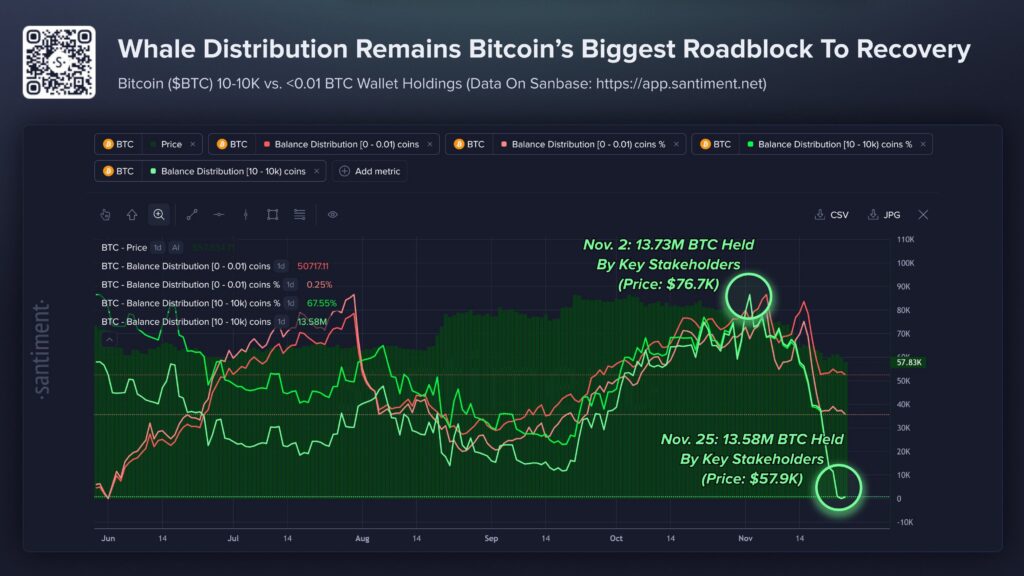
According to Santiment, the large holders it calls sharks and whales had reduced their combined holdings by about 150,000 BTC since November 2. They still controlled 67.55% of supply. Santiment said a lasting relief rally would be more convincing if those holdings first stabilized and then began to rise.
Santiment also counted about 70 positive Bitcoin comments for every 100 negative ones. The firm said pessimism of that kind has often preceded recoveries, but some traders were treating fear itself as a reason to buy. In Santiment’s view, even committed dip buyers beginning to doubt that approach would be stronger evidence of a bottom.
Analyst Benjamin Cowen offered a separate comparison: he argued that Bitcoin typically bottoms after gold and silver. Both metals fell alongside Bitcoin on November 25, and Cowen considered further Bitcoin losses the more likely outcome if metals continued to fall. In that scenario, the June low would be the first test. Below it, Glassnode’s cost-basis data pointed to potential support at $56,800 and another cluster near $46,700. On a rebound, Bitcoin faced resistance near $63,100.