For anyone holding assets on a blockchain, the distinction matters: freezing an address can stop transfers, but changing its balance through a hard fork could move funds without its private key. A proposal reported by Odaily on November 5, 2026 put that distinction before Polygon’s community. At the time of publication, it was a proposal—not an approved change.
What Polymarket and Binance proposed
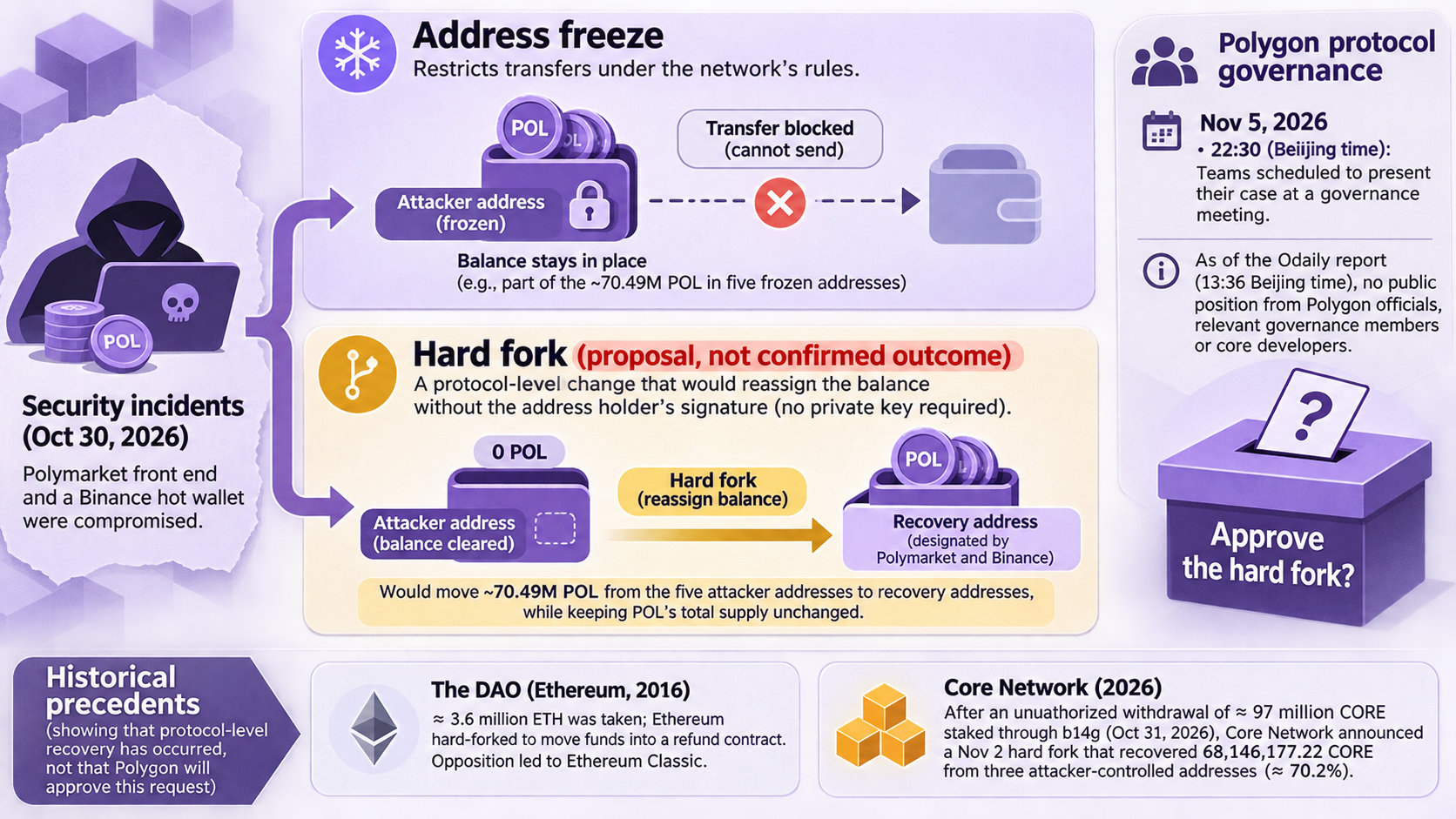
Odaily reported that Polymarket and Binance asked Polygon to hard-fork its PoS mainnet to remove approximately 70.49 million POL from five addresses identified as attackers’ addresses and credit the same amount to recovery addresses designated by the two companies. The proposal would leave POL’s total supply unchanged. The article gave differing approximate valuations for the assets—$6.7 million and $6.5 million.
According to the report, Polymarket’s front end and a Binance hot wallet were compromised on October 30. Polygon validators subsequently froze four addresses associated with the Polymarket incident, holding 23.86 million POL, and one associated with the Binance incident, holding 46.63 million POL. The freezes prevented transfers from those addresses, but did not return the funds.
Odaily said Polymarket had sought cooperation from the attacker without receiving a response. According to the proposal, an attacker also contacted Polygon validators and offered cash in exchange for unfreezing addresses. That claim was attributed to the proposal, not independently established in the article. Odaily reported that Polymarket and Binance had already compensated affected users in full.
The teams were scheduled to present their case at a Polygon protocol governance meeting at 22:30 Beijing time on November 5. As of Odaily’s 13:36 Beijing time publication, it reported no public position on the proposal from Polygon officials, relevant governance members or core developers. The source did not establish how the meeting or proposal ultimately concluded.
Why the custody boundary matters
A freeze restricts what an address can do under the network’s rules. The proposed hard fork would go further: it would change balances without a signature from the keys controlling those addresses. Polymarket and Binance said in their proposal that the action would apply only to the specified incidents and should not become a routine recovery mechanism.
Odaily compared the proposal with two earlier interventions. After the 2016 The DAO exploit, in which approximately 3.6 million ETH was taken, Ethereum hard-forked to move funds into a refund contract; opposition to that decision led to Ethereum Classic. The article also reported that, after an unauthorized withdrawal of approximately 97 million CORE staked through b14g on October 31, 2026, Core Network announced a November 2 hard fork that recovered 68,146,177.22 CORE from three attacker-controlled addresses—about 70.2% of the affected CORE.
Those examples show that protocol-level recovery has precedents, but not that Polygon would approve this request. For long-term holders, the practical question raised by the proposal is which protections depend on a private key and which depend on validators and governance decisions. A frozen address and a reassigned balance are different forms of intervention, even when both are proposed in response to theft.
Source: odaily.news (originally published 2026-11-05 13:36 UTC+8)