For long-term ETH holders, the practical question is whether accounts could move to quantum-resistant protection before existing cryptography becomes unsafe. No wallet migration is required by this proposal today. As reported on November 12, 2026, nonprofit Ethereum research lab Ethlabs had posted a community proposal called pqai27 that sets 2027 as a target for making Ethereum resistant to quantum and AI-related threats. The roadmap still requires discussion and agreement among Ethereum’s core developers.
Ethlabs divides the work into two goals. The first, “pqai-ready,” calls for a quantum-resistant consensus layer and a way for users to migrate to quantum-resistant accounts through Frames, the account-abstraction proposal EIP-8141. It also proposes that, if existing cryptography fails early, the network could fall back to using calldata to keep operating. These are proposed capabilities, not protections holders can assume are already in place.
The second goal, “pqai-scaled,” concerns capacity after that baseline is established. Ethlabs proposes quantum-resistant signature aggregation under EIP-8288 and quantum-resistant data availability under EIP-8479, aiming to restore normal transaction and blob throughput after scaling.
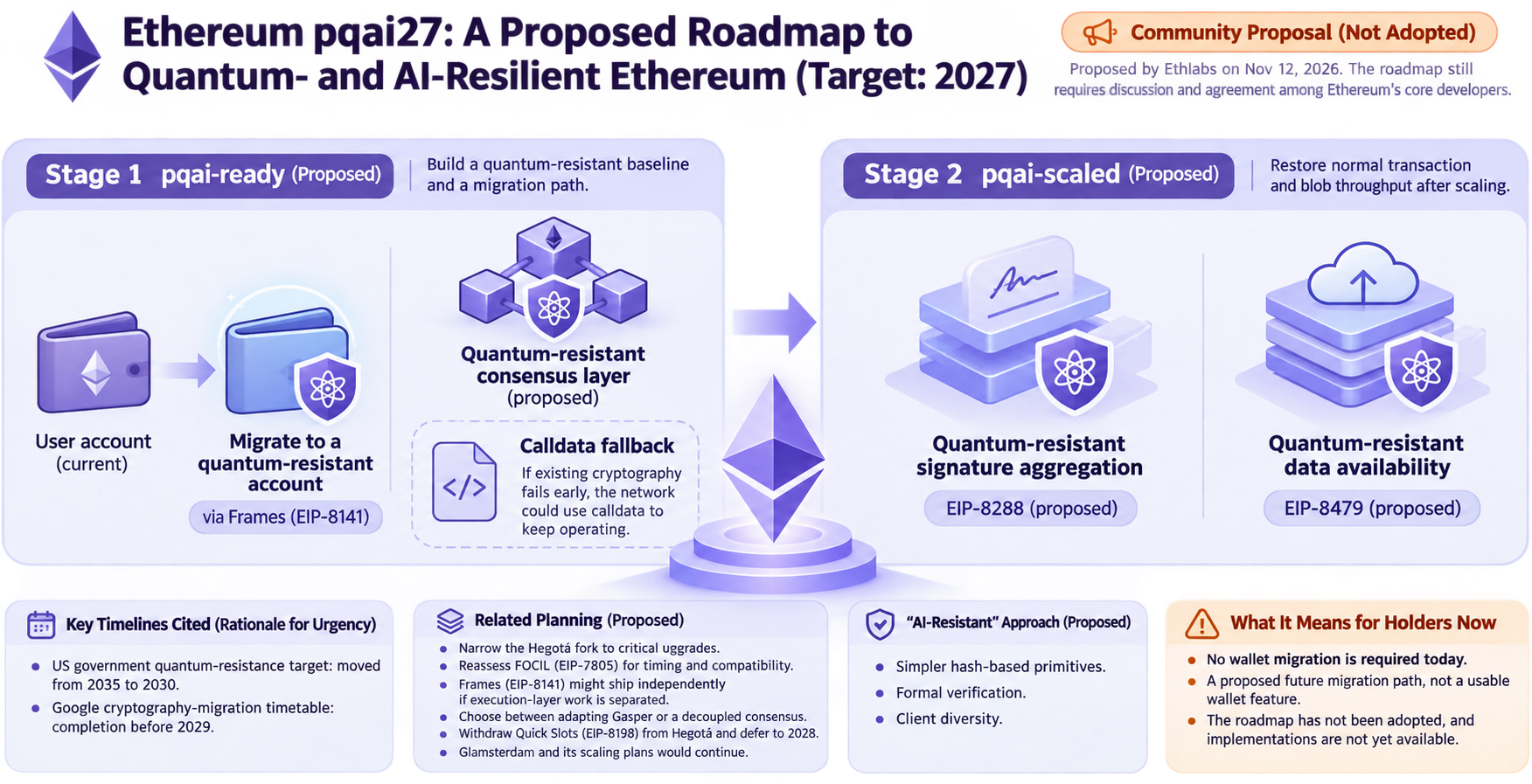
To make room for the work, Ethlabs recommends narrowing the planned Hegotá fork to critical upgrades and reassessing how the censorship-resistance proposal FOCIL (EIP-7805) would affect timing and compatibility. Frames might ship independently if execution-layer work is separated from consensus-layer dependencies. Developers would also need to choose between adapting the existing Gasper consensus system and moving to a decoupled approach. Ethlabs said it was withdrawing its Quick Slots proposal, EIP-8198, from Hegotá and deferring it to 2028; the proposal says Glamsterdam and its scaling plans would continue.
Ethlabs cites compressed security timelines as its reason for urgency: the reported US government quantum-resistance target moved from 2035 to 2030, while Google’s published cryptography-migration timetable targets completion before 2029. The proposal’s “AI-resistant” aim centers on simpler hash-based primitives, formal verification and client diversity. These arguments explain the proposed timetable; they do not mean the roadmap has been adopted.
For holders, the distinction is between a proposed future migration path and a usable wallet feature. Until developers settle the roadmap and implementations become available, there is no pqai27-specific account change to make. At the November 12 reporting date, DeFiLlama put Ethereum’s total value locked above $41.16 billion—a measure of the network’s scale, not evidence that the proposed protections were already active.