
For long-term holders, a private receiving address is more useful if it does not require moving spending-key operations into a browser wallet. As reported by Deep Tide TechFlow on November 18, 2026, Ethereum privacy researcher Pierre announced a stealth addresses working group focused on ERC-5564 and hardware-wallet integration. These are engineering goals, not features holders can assume are available today.
The group brings together the Ethereum Foundation, Umbra developer ScopeLift, stealth-address wallet Fluidkey and hardware-wallet maker Trezor. It plans to meet every two weeks. Its work includes a proposed hybrid approach combining elliptic-curve cryptography with ML-KEM, intended to protect historical transfer records against future quantum-assisted tracing. It also aims to produce an independent, production-grade reference implementation; the report says two independent implementations and a system-level code audit are prerequisites for moving ERC-5564 to Final status.
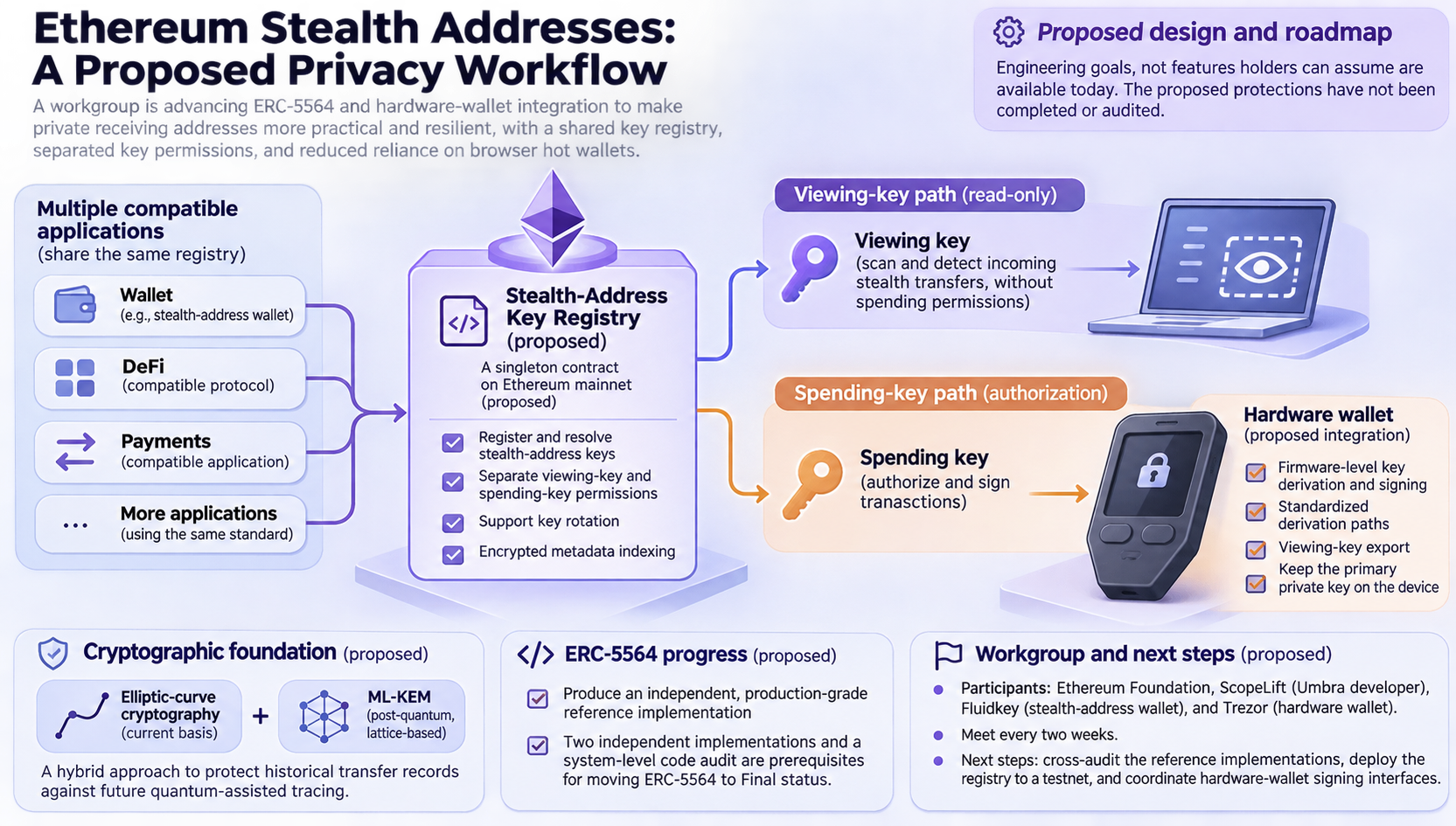
For people managing keys across applications, another proposal is a single key-registry contract on Ethereum mainnet. It would provide a common way to register and resolve stealth-address keys, rather than requiring a user to publish a stealth meta-address separately in each application. The proposed design separates spending-key and viewing-key permissions and supports key rotation and encrypted metadata indexing.
The group also plans to work with Trezor on firmware-level key derivation and signing, including standards for derivation paths and viewing-key export. Its stated aim is to reduce reliance on browser hot wallets and local scripts while keeping the primary private key on the hardware device. The reported next steps include cross-auditing the reference implementations, deploying the registry to a testnet and coordinating hardware-wallet signing interfaces. None of those steps establishes that the proposed protections have been completed or audited.