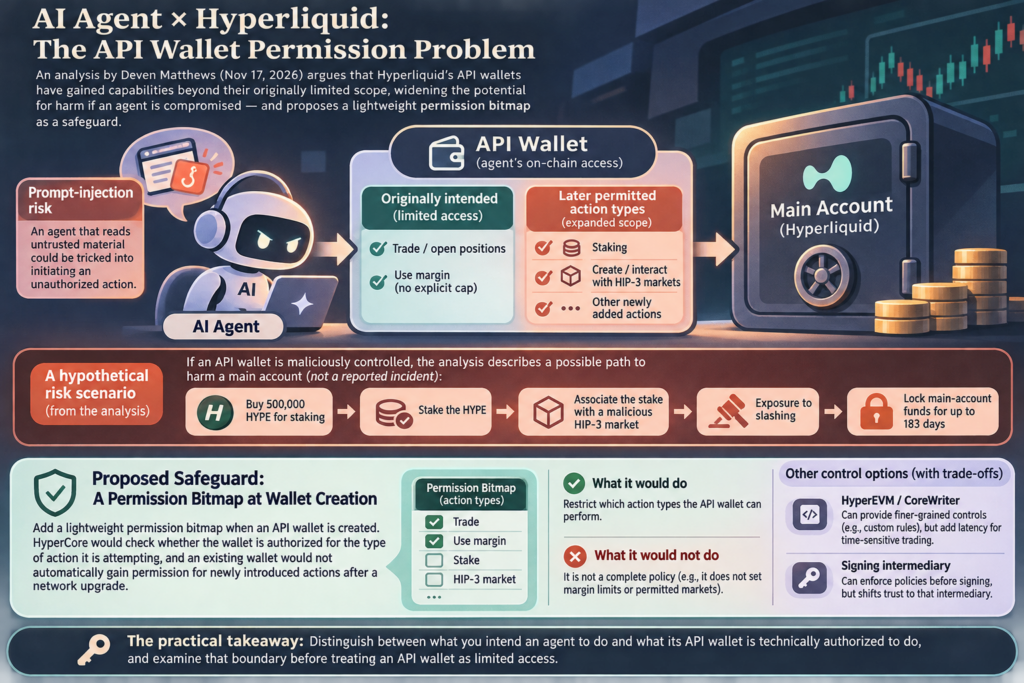
Giving an AI agent access to a trading account raises a custody question: if the agent makes a harmful decision, what can its API wallet actually do? In an analysis published on November 17, 2026, Deven Matthews argued that Hyperliquid’s API wallets had gained capabilities beyond the limited access originally expected of them. The article describes potential attack paths, not a confirmed account compromise or loss.
The permission concern
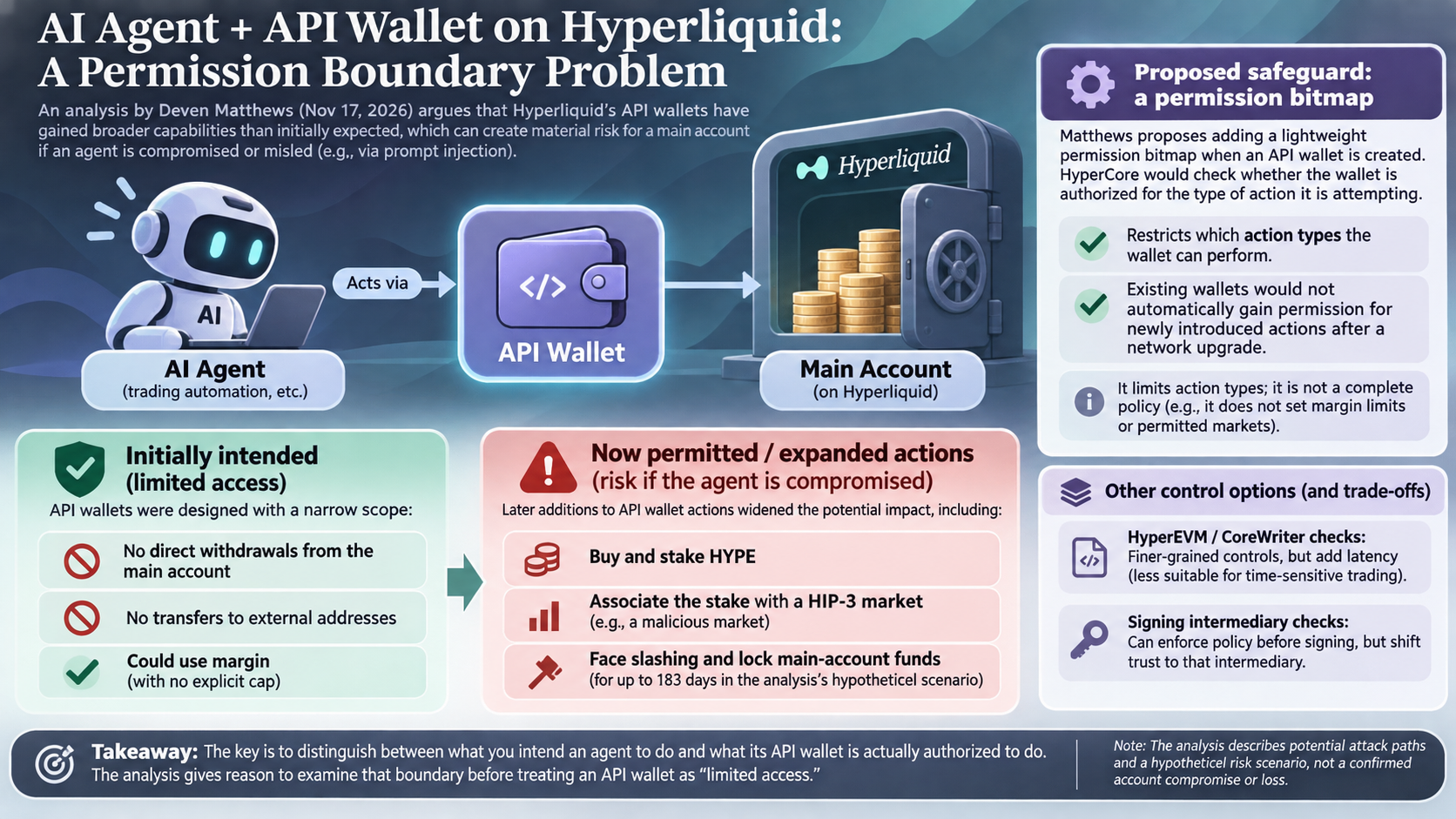
Matthews wrote that API wallets were initially unable to withdraw directly from a main account or transfer to external addresses. That boundary did not limit how much margin they could use, however. In his assessment, later additions to the actions available to API wallets widened the ways a compromised wallet—or an agent steered by a malicious instruction—could harm the main account.
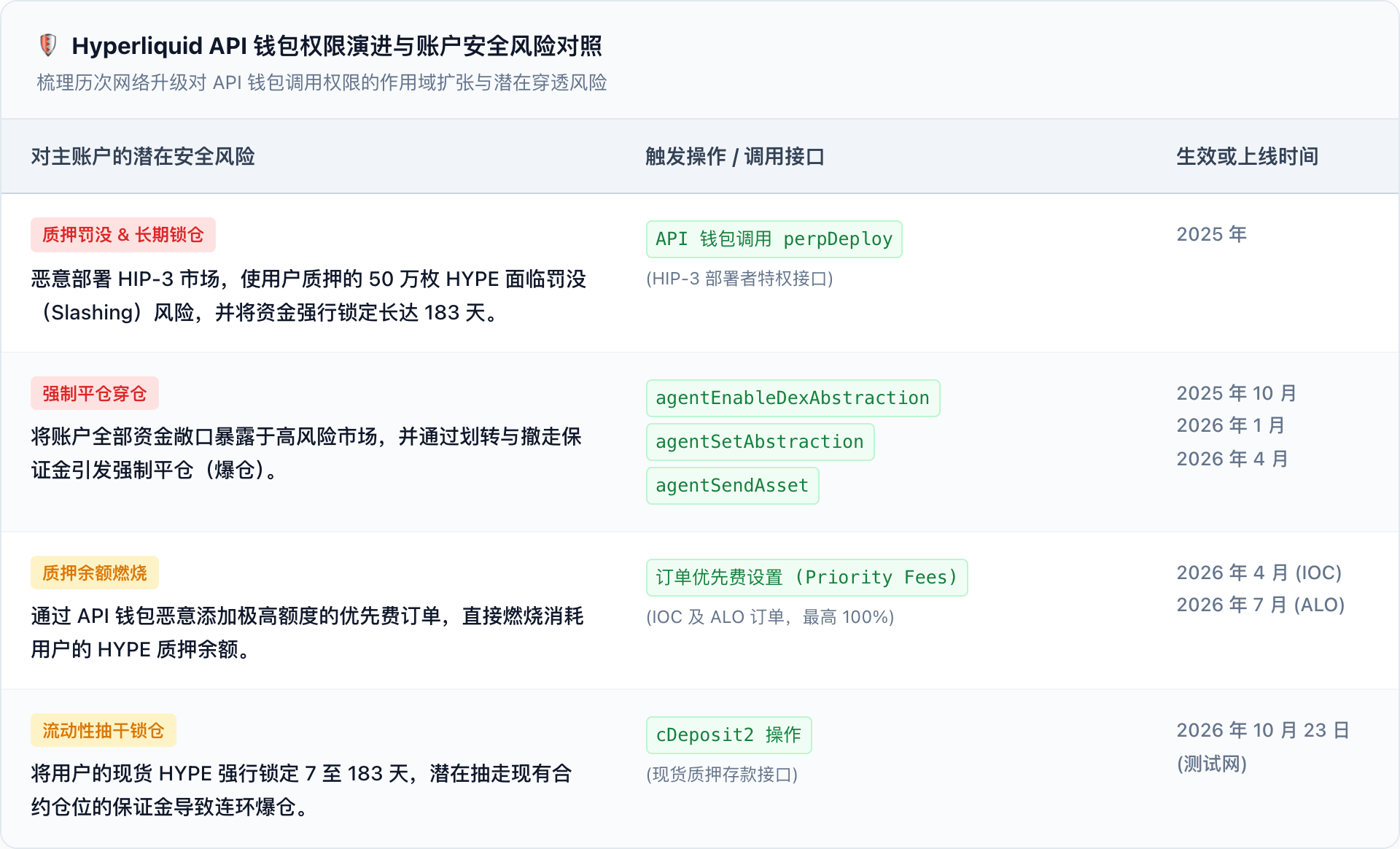
One scenario in the analysis assumes a main account with more than approximately $40 million in assets. Matthews argued that a maliciously controlled API wallet could buy 500,000 HYPE for staking, associate the stake with a malicious HIP-3 market, expose it to slashing and lock main-account funds for up to 183 days. This is a hypothetical risk scenario, not a reported incident.
The concern is not limited to stolen keys. An agent that reads untrusted material could also encounter a prompt-injection attempt and initiate an unauthorized action itself, Matthews warned.
What the proposed safeguard would—and would not—do
Matthews proposed adding a lightweight permission bitmap when an API wallet is created. HyperCore would check whether that wallet is authorized for the type of action it is attempting. Under the proposal, an existing wallet would not automatically gain permission for newly introduced actions after a network upgrade. This is a proposal, not an enacted Hyperliquid rule.
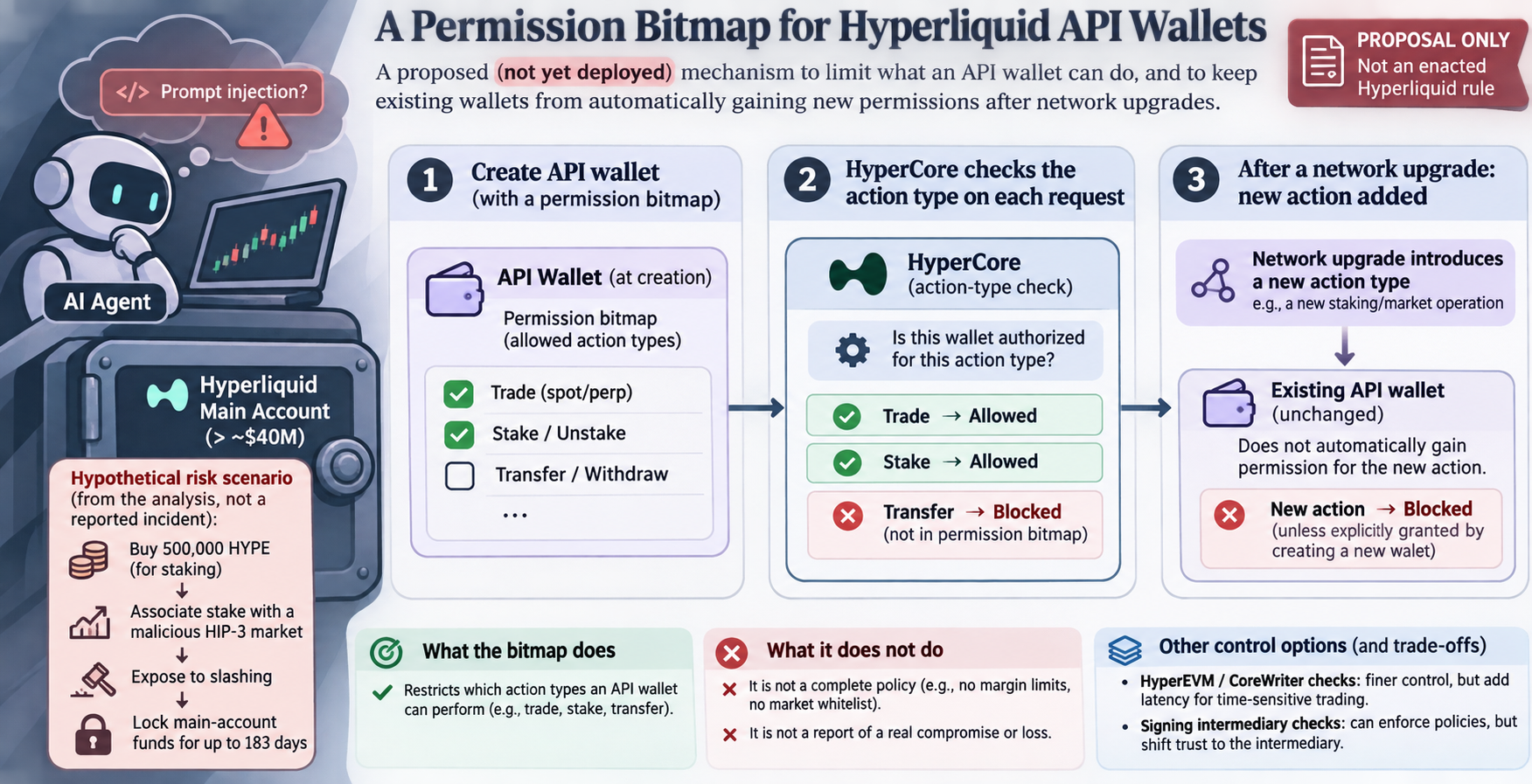
The bitmap described in the analysis would restrict action types; it is not the same as a complete policy setting margin limits or permitted markets. Matthews also noted that smart-contract checks through HyperEVM and CoreWriter can provide finer controls but add latency for time-sensitive trading, while checks by a signing intermediary shift trust to that intermediary.
For anyone considering agent access, the practical distinction is between what they intend an agent to do and what its API wallet is technically authorized to do. The analysis gives reason to examine that boundary before treating an API wallet as limited access.