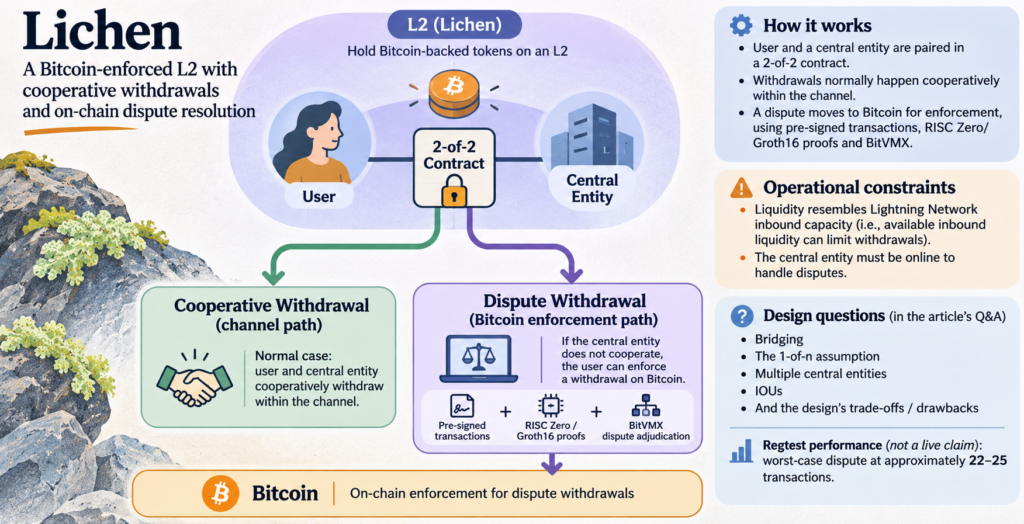
For someone holding Bitcoin-backed tokens on an L2, the key custody question is what happens if the central entity does not cooperate with a withdrawal. In an article published on November 11, 2026, Lichen is described as pairing each user with a central entity in a 2-of-2 contract. Withdrawals normally happen cooperatively within the channel; a dispute instead moves to Bitcoin for enforcement.
The design uses pre-signed transactions, RISC Zero/Groth16 proofs and BitVMX dispute adjudication to let users withdraw without having to trust the central entity to approve the withdrawal. That does not remove every operational constraint: the article says liquidity resembles Lightning Network inbound capacity, and the central entity must be online to handle disputes.
The author also discusses bridging, the 1-of-n assumption, multiple central entities and IOUs as design questions. In regtest performance data, the article puts a worst-case dispute at approximately 22–25 transactions. That is a regtest figure, not a claim about the cost or timing of a live dispute.