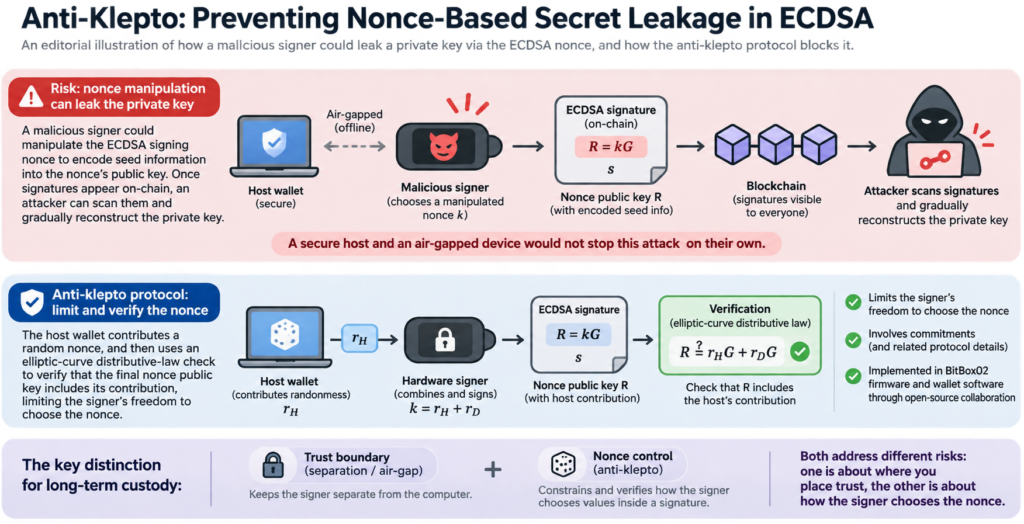
Keeping a hardware signer offline does not, by itself, rule out every way a compromised device could leak secrets. An article published on November 5, 2026, at 11:33 (UTC+8) explains a risk in ECDSA signing: a malicious device could manipulate the signing nonce to encode seed information in the nonce’s public key. Once signatures appear on-chain, an attacker could scan them and gradually reconstruct the private key. According to the article, a secure host and an air-gapped device would not stop that attack on their own.
The anti-klepto protocol limits the signer’s freedom to choose that nonce. The host wallet contributes a random nonce, then uses an elliptic-curve distributive-law check to verify that the final nonce public key includes its contribution. The article also discusses commitments, protocol details, and implementation in BitBox02 firmware and wallet software through open-source collaboration.
For long-term custody, the distinction is worth understanding: keeping a signer separate from a computer addresses one trust boundary, while anti-klepto addresses how a signer chooses values inside a signature.