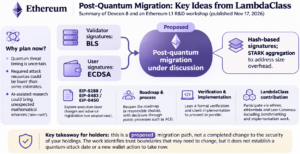
For long-term holders, the question raised by Ethlabs is whether Ethereum accounts and the network behind them will have a workable path to stronger cryptographic protection. In a proposal reported on November 12, 2026, Ethlabs urged Ethereum to aim for “post-quantum and post-AI” readiness in 2027. This is a proposed priority, not an enacted protocol change or a requirement for wallet holders to act now.
Ethlabs argued that AI is accelerating both quantum-computing timelines and attackers’ ability to find vulnerabilities at scale. Its proposed goal, pqai27, calls for post-quantum migration paths for consensus and accounts, alongside clients hardened against large-scale vulnerability discovery by frontier AI models.
To make room for that work, Ethlabs proposed revisiting the scope of Hegotá: delaying FOCIL while retaining Frames and the post-quantum account EIP. It described a sequence of reaching pqai-ready in 2027 before pursuing pqai-scaled. Ethlabs also said it would withdraw its quick slots proposal and direct resources toward wallet and validator-key migration, client hardening, and formal verification.
For now, the distinction for holders is between a proposed migration path and one that has been implemented. The notice does not specify a wallet change that users need to make.