If you plan to hold ETH for years, the relevant question is whether the cryptography protecting users and validators can be changed before a quantum threat becomes practical. The timing remains uncertain; this is a planning concern, not a claim that wallets are currently compromised.
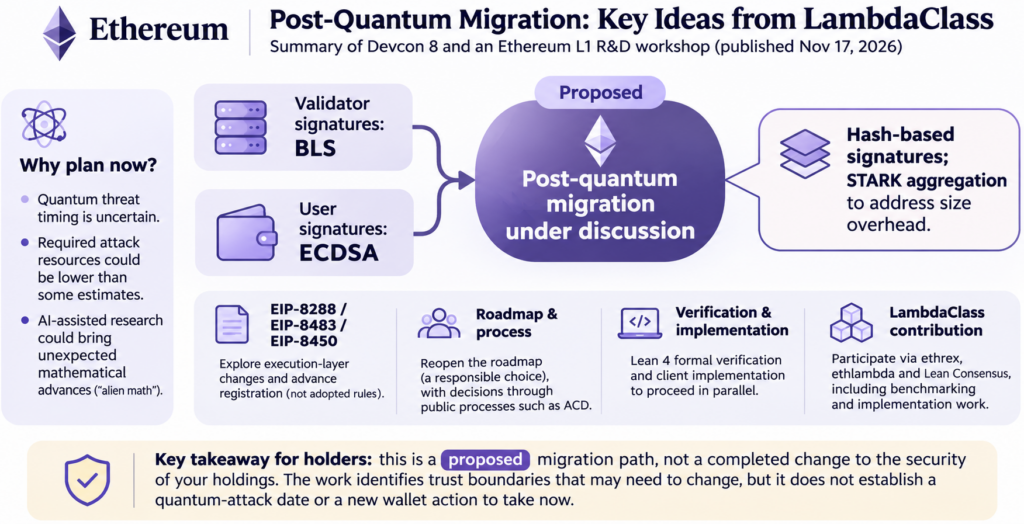
In a summary of Devcon 8 and an Ethereum L1 R&D workshop published on November 17, 2026, LambdaClass argued that Ethereum needs to complete a post-quantum cryptography migration by the end of 2028. That is LambdaClass’s proposed timeline, not an enacted network deadline. Its case for starting early rests partly on the possibility that estimates of the resources needed for an attack could fall. It also raised the possibility that AI-assisted research could produce unexpected mathematical advances—an uncertainty it called “alien math.”
The work discussed includes replacing the BLS signatures used by validators and the ECDSA signatures used by users. LambdaClass described hash-based signatures as a favored direction, with STARK-based signature aggregation as a way to address signature-size overhead. EIP-8288, EIP-8483 and EIP-8450 explore execution-layer changes and advance registration; the summary does not present them as adopted rules.
LambdaClass argued that reopening the roadmap would be a responsible choice, with decisions made through public processes such as ACD. It also called for Lean 4 formal verification and client implementation to proceed in parallel, and said it would contribute through ethrex, ethlambda and Lean Consensus, including benchmarking and implementation work.
For holders, the distinction is between a proposed migration path and a completed change to the security of their holdings. The reported work identifies trust boundaries that may need to change, but it does not establish a quantum-attack date or a new wallet action to take now.