If you hold ether for the long term, the useful question is not whether a quantum computer can empty a wallet now. It is whether an address that has already sent a transaction has left a public key on the chain that a far more powerful machine could someday misuse, and what recovering those funds would actually require.
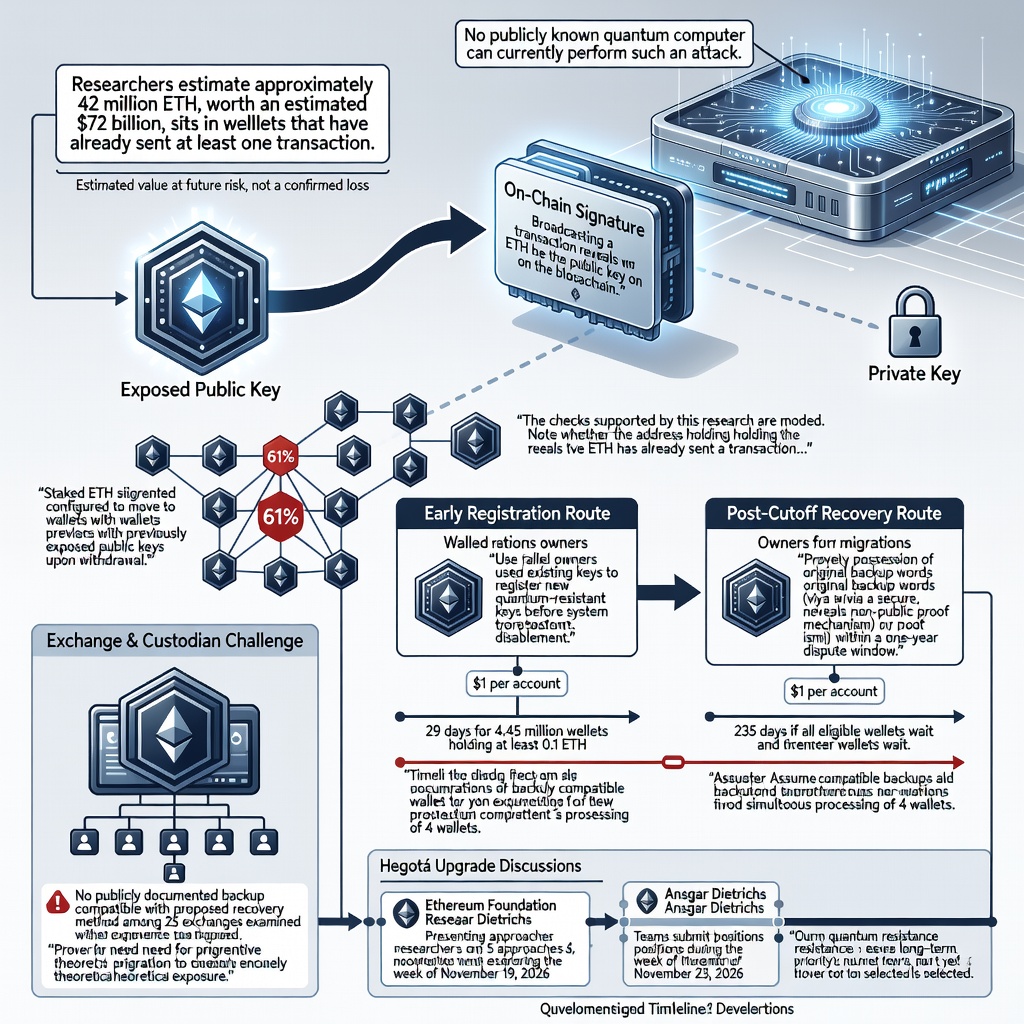
Reporting published on November 24, 2026 described work by researchers at the University of Pittsburgh and the Chicago-based security firm SeQure. They estimated that approximately 42 million ETH, worth an estimated $72 billion, sits in wallets that have already sent at least one transaction, so the associated public keys can already be derived. They looked at how much of Ethereum’s supply could be at risk if quantum computers became capable of breaking the cryptography used by existing wallets. They stressed that no publicly known quantum computer can currently perform such an attack. The $72 billion figure is an estimate of value under a future scenario, not a confirmed loss.
Ethereum wallets authorize transfers with cryptographic signatures. The public key lets the network verify that the owner approved a transaction. The private key stays secret and is what controls the funds. Under current cryptographic assumptions, deriving a private key from its public counterpart is impractical. The researchers’ narrower point is that once a wallet sends a transaction, its public key can be derived from the signature recorded on the blockchain. A sufficiently advanced quantum computer could, in theory, use that information to calculate the private key and take control of the funds.
The exposure is not limited to ether already sitting in active wallets. The researchers found that 61% of staked ether is configured to move, once withdrawn, to wallets with previously exposed public keys. Updating the network’s cryptographic standards would not finish the job on its own. Wallet owners, staking participants, and institutional custodians would also need to move funds into compatible quantum-resistant arrangements.
The study proposes two routes toward those arrangements. Neither is an enacted Ethereum rule, and neither should be read as a network schedule.
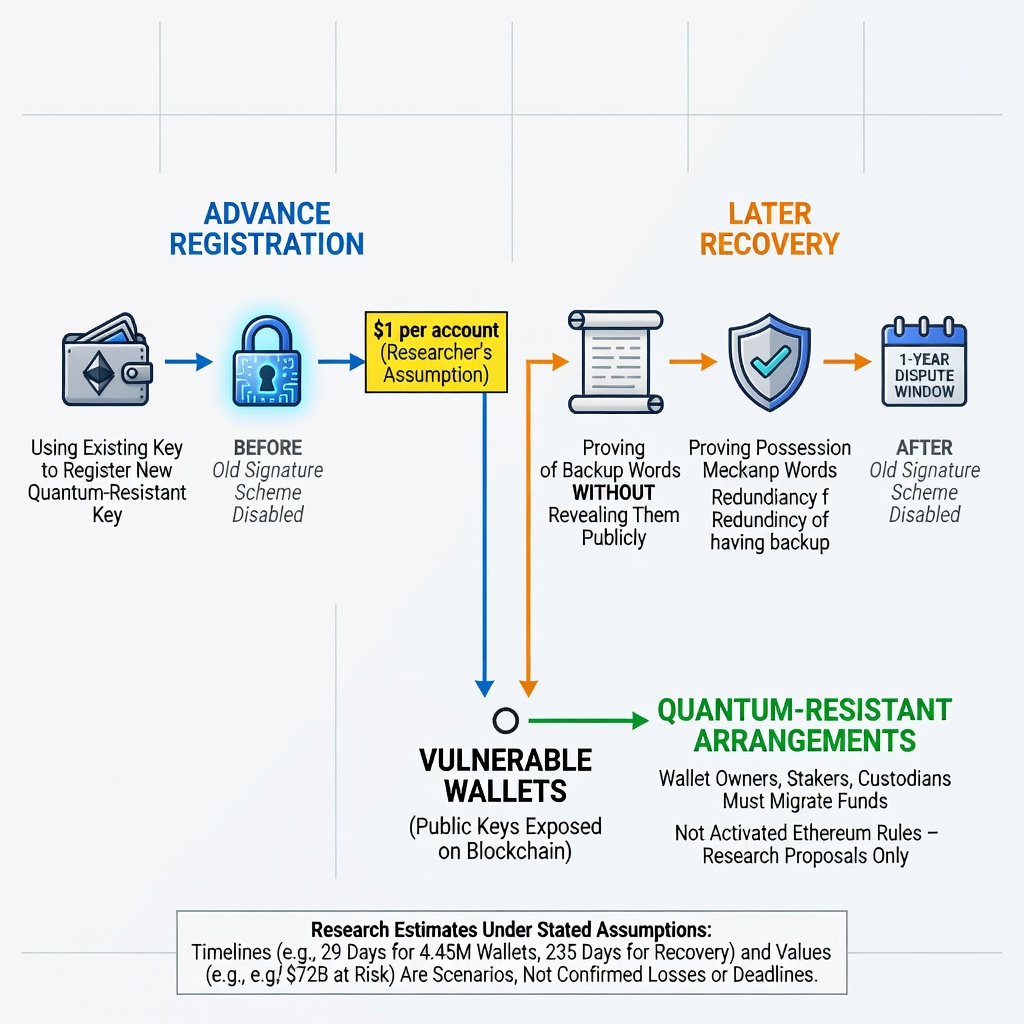
In the first, owners would use their existing keys to register new, quantum-resistant keys before the old signature system was disabled. Under the study’s assumptions, that process could cost approximately $1 per account.
In the second, used only if the original signature system had already been disabled, owners would recover access by proving that they still possess their original wallet backup words, without revealing those words publicly. The mechanism is meant to give legitimate owners a path back to the funds and to leave time for fraudulent registrations to be challenged. The proposal includes a one-year window after the cutoff for owners to dispute unauthorized key registrations. Confidentiality matters here: the proof is designed not to publish the words. Still having a backup is a form of redundancy, not evidence that a custody setup removes this risk. Accessibility is different again: early registration uses keys the owner already controls, while later recovery depends on a compatible backup and on getting a transaction included.
The researchers tested proof generation on a laptop and found that it took approximately two minutes. Processing millions of recovery transactions on Ethereum would take considerably longer, because those transactions would compete with ordinary network activity for block space.
Their estimates of that congestion are scenarios, not a confirmed migration timetable. They depend on assumptions about network capacity and wallet participation:
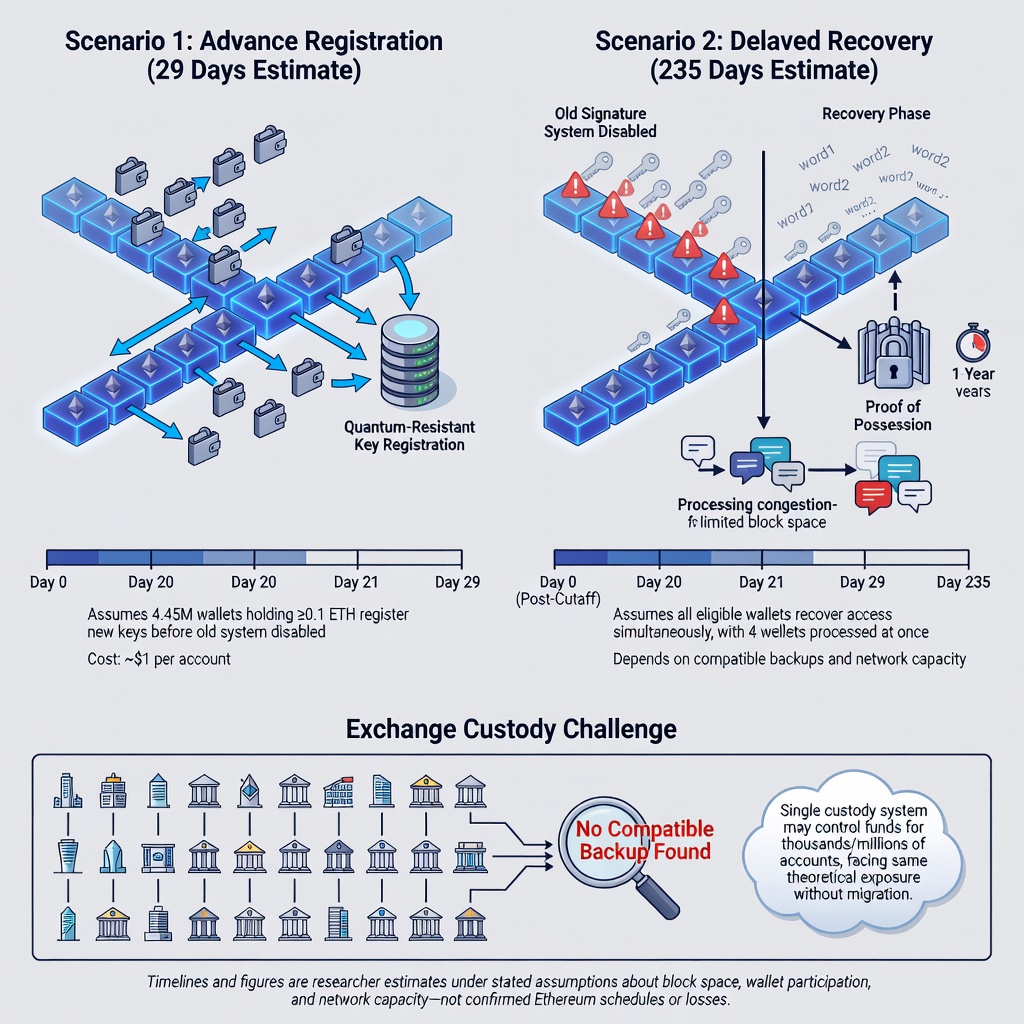
- About 29 days for 4.45 million wallets holding at least 0.1 ETH to register new keys in advance.
- About 235 days if all eligible wallets waited until after the old signatures were disabled and then needed to recover access, assuming compatible backups and four wallets processed at the same time.
The same review looked at exchanges and institutional custodians. Among the custody systems of the 25 exchanges examined, the researchers found no publicly documented backup compatible with the proposed recovery method. Exchanges often hold assets for large numbers of customers, so one custody system may control funds belonging to thousands or millions of accounts. If a custodian could not use that recovery mechanism, it might need to migrate its wallets before the existing signature system became vulnerable. Otherwise those assets could face the same theoretical exposure as individually managed wallets. That is a finding about public documentation and operations, not a report of customer funds already taken.
Ethereum developers were separately discussing quantum-resistant features for a future upgrade. On November 19, 2026, Ethereum Foundation researcher Ansgar Dietrichs presented developers with five possible approaches for the planned Hegotá upgrade. One option focused on introducing quantum defenses. Teams that maintain Ethereum’s software were expected to submit written positions during the week of November 23, 2026. Those discussions show quantum resistance entering longer-term development priorities. No final approach had been selected. The researchers’ migration plan is not an approved network-wide upgrade. Any real path would still have to balance security improvements against compatibility, transaction costs, and the difficulty of moving funds across millions of wallets.
The checks supported by this research are modest. Note whether the address holding the ETH has already sent a transaction, which is what exposes the public key in this study. If ether is staked, note whether withdrawals are pointed at a wallet whose public key is already exposed. Keep backup words private; the second proposal depends on proving possession without publishing them, and nothing in the study asks a holder to type those words into a service. Treat the dollar figure and the day counts as researcher estimates under stated assumptions, not as a present compromise of Ethereum or as a deadline the protocol has set.