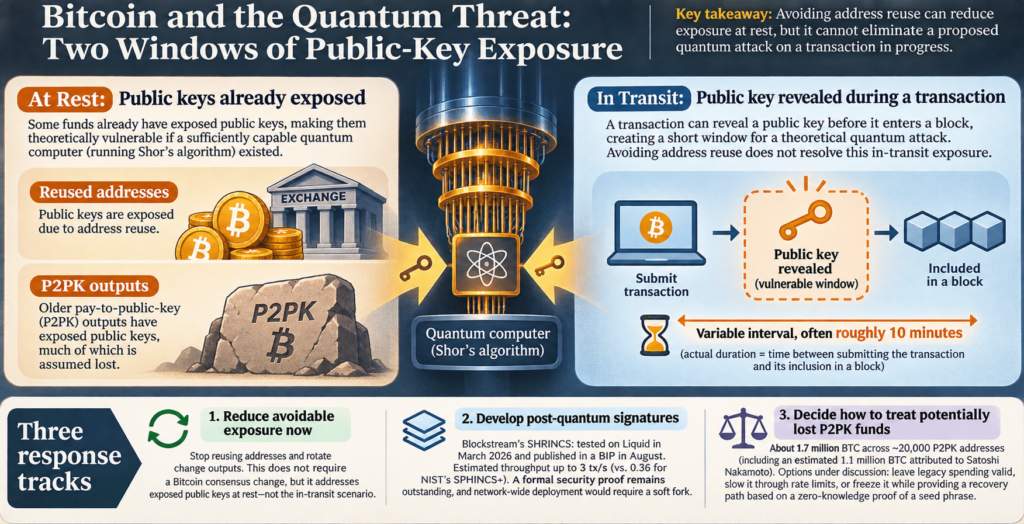
For a long-term Bitcoin holder, the most practical point in a November 2026 report from the Bitcoin Security Consortium is straightforward: avoiding address reuse can reduce one form of quantum exposure, but it cannot eliminate every proposed quantum attack. The report, produced with Presidio Bitcoin, distinguishes funds whose public keys are already exposed from transactions that reveal a public key while they are being confirmed.
Two different windows of exposure
A sufficiently capable quantum computer running Shor’s algorithm could, in theory, derive a Bitcoin private key from an exposed public key. The report says no cryptographically relevant quantum computer has been demonstrated. It also stresses that the proposed attack concerns Bitcoin’s signature scheme, not its supply cap or issuance schedule.
At rest: Reused addresses and older pay-to-public-key (P2PK) outputs have exposed public keys. Project Eleven estimates that about 7.1 million BTC, roughly 35% of the total, would be vulnerable to theft if a capable machine existed today. The report says about three-quarters of that amount is held in reused addresses, much of it at large exchanges. Moving funds to fresh, unused addresses and avoiding reuse could reduce this exposure. It separately identifies about 1.8 million BTC in P2PK outputs, much of which is assumed lost and may not be movable.
In transit: A transaction can reveal a public key before it enters a block. That creates a window often described as roughly 10 minutes, though its actual duration is the time between submitting the transaction and its inclusion in a block. Google estimates that a sufficiently fast, prepared quantum device could theoretically derive a private key in as little as nine minutes. Avoiding address reuse does not resolve this proposed in-transit attack.
Why the risk is neither immediate nor dismissible
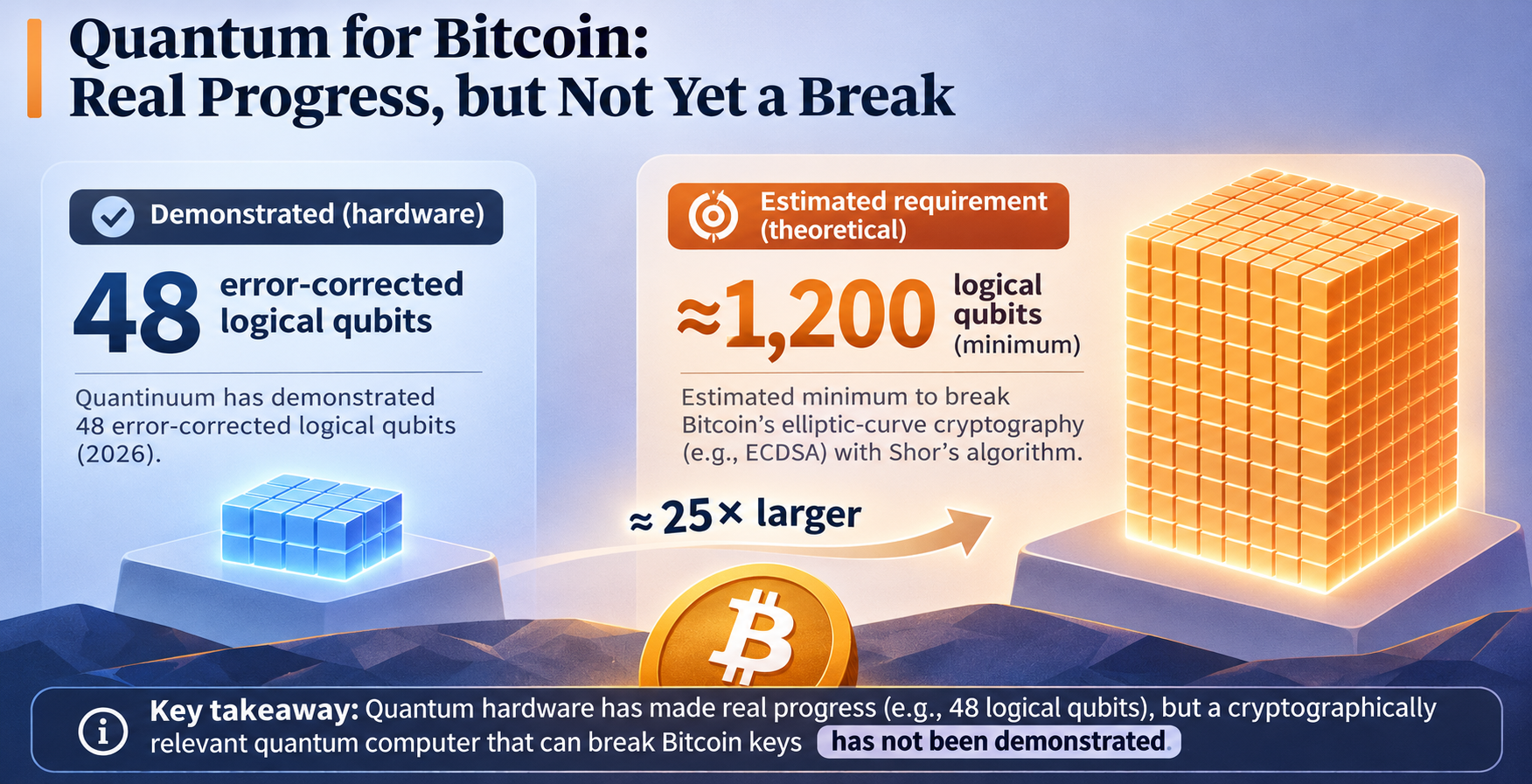
The report contrasts research progress with the hardware still required. It says Quantinuum has demonstrated 48 error-corrected logical qubits, while breaking Bitcoin’s elliptic-curve cryptography would require at least approximately 1,200. Google’s Willow error-correction demonstration and the 2026 Shor-algorithm work are advances, not demonstrations of a machine breaking Bitcoin keys.
At the same time, the report says Google’s 2026 circuit work reduced an earlier estimate of the logical-qubit requirement by about 20-fold, and ECDSA.fail subsequently reduced Google’s circuit by nearly 70%. These are estimates and optimizations, not observed thefts. The report also cites a recent expert survey assigning roughly a 50% probability to a capable machine appearing between 2030 and 2035; that is a forecast, not a deadline or a confirmed arrival date.
Three response tracks
The report identifies three areas of work:
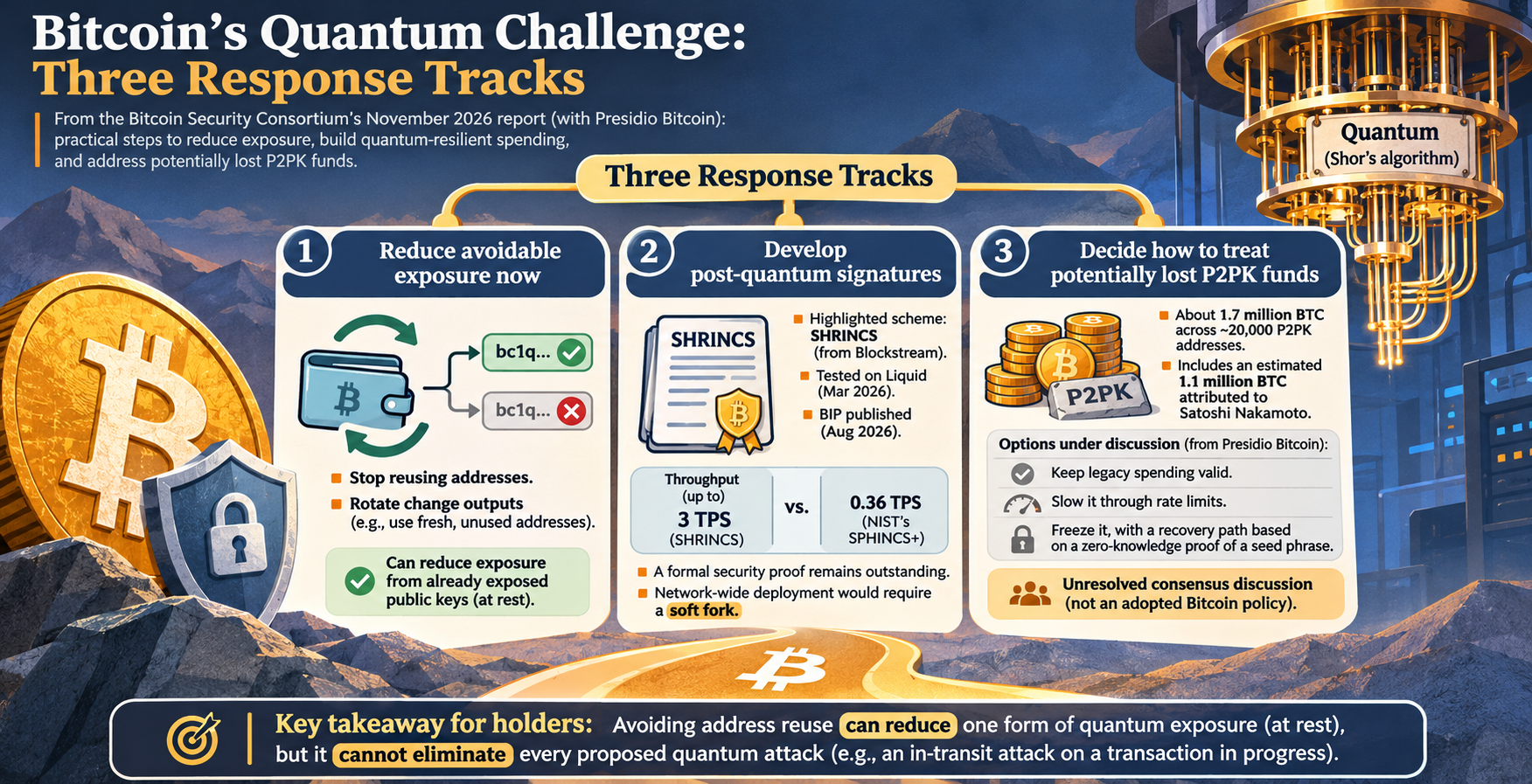
- Reduce avoidable exposure now. Holders and custodians can stop reusing addresses and rotate change outputs. This does not require a Bitcoin consensus change, but it addresses exposed public keys at rest—not the in-transit scenario.
- Develop post-quantum signatures. The report highlights Blockstream’s proposed SHRINCS scheme. It says Blockstream tested it on Liquid in March 2026 and published a Bitcoin Improvement Proposal with other contributors in August. The report estimates throughput of up to three transactions per second, compared with 0.36 for NIST’s standard SPHINCS+. A formal security proof remains outstanding, and network-wide deployment would require a soft fork.
- Decide how to treat potentially lost P2PK funds. This is a separate policy question. The report cites about 1.7 million BTC across approximately 20,000 P2PK addresses, including an estimated 1.1 million BTC attributed to Satoshi Nakamoto. Presidio Bitcoin describes options under discussion: leave legacy spending valid, slow it through rate limits, or freeze it while providing a recovery path based on a zero-knowledge proof of a seed phrase. These are proposals, not an agreed Bitcoin policy. The report’s 1.7 million BTC policy estimate should not be conflated with its separate 1.8 million BTC exposure estimate.
For holders, the report supports one manageable distinction: address reuse is an exposure that can be reduced through current practices; protection against a sufficiently fast attack on a transaction in progress depends on further technical development and agreement.
Source: chaincatcher.com (originally published 2026-11-12 09:18 UTC+8)