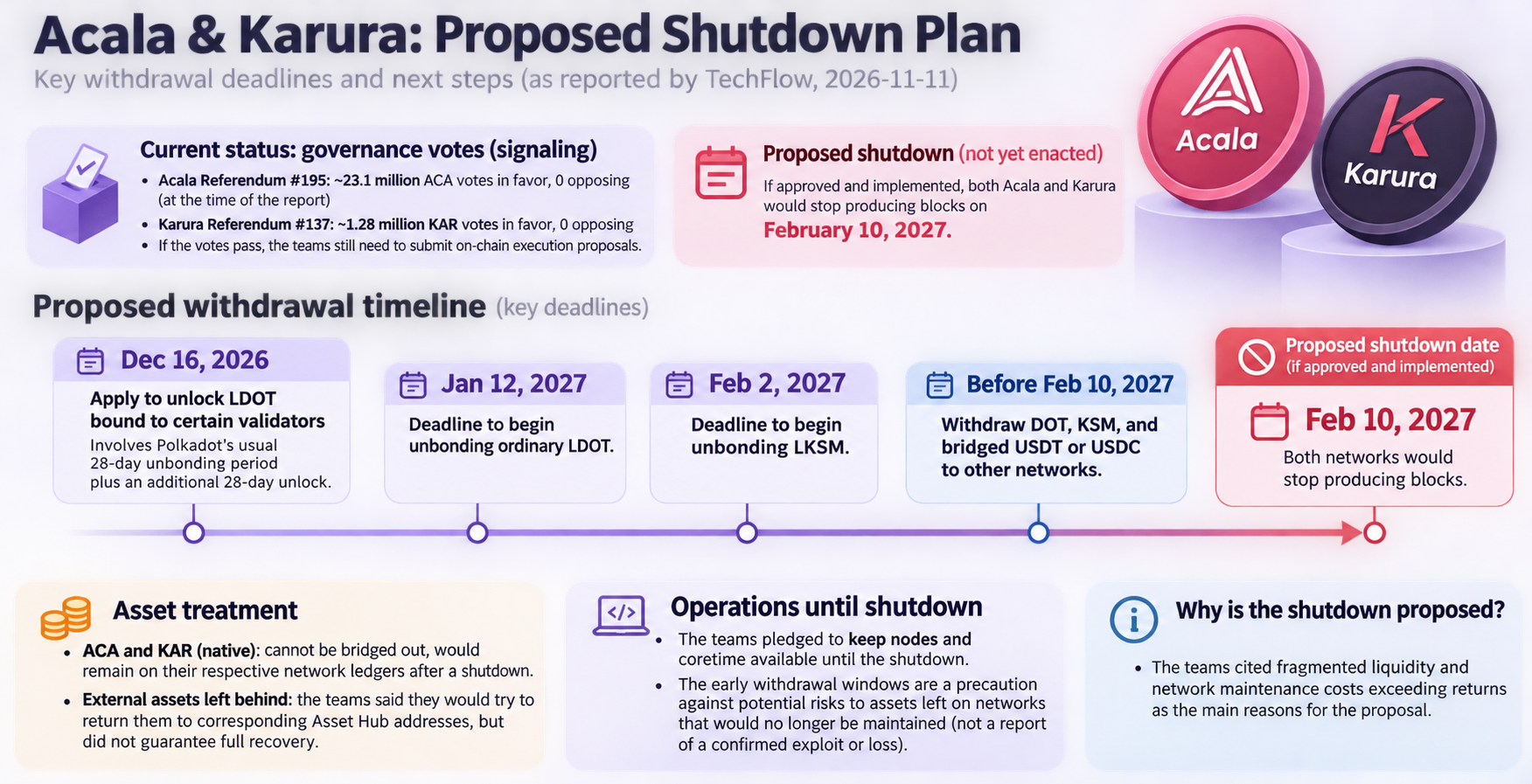
If you hold assets on Acala or Karura, the immediate question is whether you would need to move them before the chains stop operating. As reported by TechFlow on November 11, 2026, both networks had opened governance votes on proposed shutdowns—not completed shutdowns. If approved and implemented, they would stop producing blocks on February 10, 2027.
Acala Referendum #195 and Karura Referendum #137 were signaling votes at the time of the report. TechFlow said on-chain data showed roughly 23.1 million ACA votes in favor on Acala and 1.28 million KAR votes in favor on Karura, with no opposing votes recorded at that point. Even if those votes pass, the teams would still need to submit on-chain execution proposals.
Dates relevant to withdrawals
The proposed plan sets different deadlines depending on the asset:
- December 16, 2026: Apply to unlock LDOT bound to certain validators. The report says this involves Polkadot’s usual 28-day unbonding period plus an additional 28-day unlock.
- January 12, 2027: Deadline to begin unbonding ordinary LDOT.
- February 2, 2027: Deadline to begin unbonding LKSM.
- Before February 10, 2027: Withdraw DOT, KSM, and bridged USDT or USDC to other networks.
The report says native ACA and KAR cannot be bridged out and would remain on their respective network ledgers after a shutdown. The teams said they would try to return external assets left behind to corresponding Asset Hub addresses, but did not guarantee full recovery. They also pledged to keep nodes and coretime available until shutdown.
The teams cited fragmented liquidity and network maintenance costs exceeding returns as reasons for the proposal. TechFlow described the early withdrawal windows as a precaution against potential risks to assets left on networks that would no longer be maintained—not as a report of a confirmed exploit or loss.
Source: techflowpost.com (originally published 2026-11-11 14:05 UTC+8)