For anyone holding crypto long term, recovery is part of custody: a backup must be accessible when needed, but not to someone else. In an article published on November 10, 2026, Liu Jiaolian examined that trade-off after reporting that assets had been taken from thousands of Keplr social-login accounts. Liu said Keplr attributed the incident to a Web3Auth infrastructure vulnerability. The technical cause had not been disclosed in detail, and Liu’s account should not be read as a confirmed explanation of how the theft occurred.
Liu compared four ways to hold or recover a wallet key:
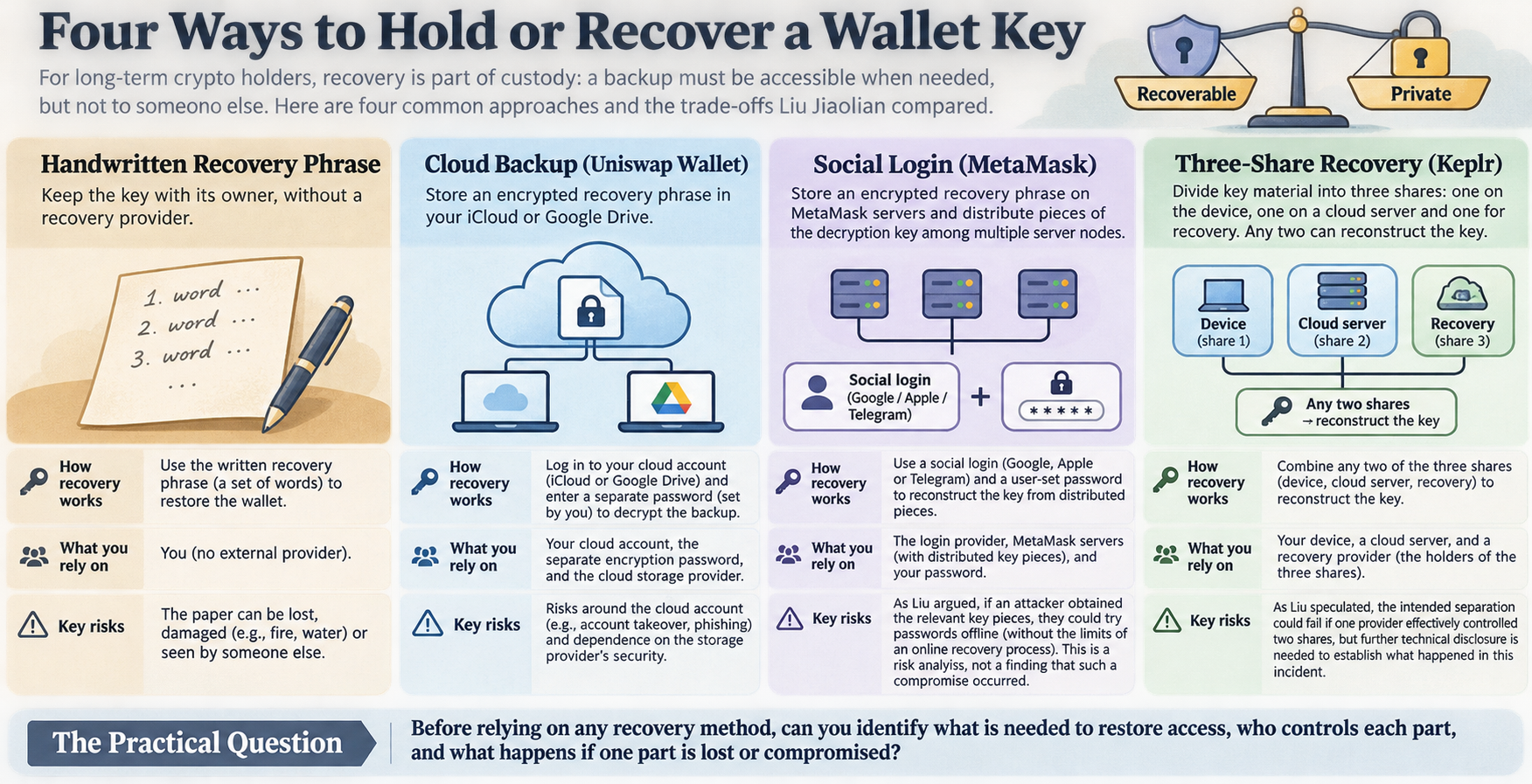
- A handwritten recovery phrase keeps the key with its owner, without a recovery provider. Its weakness is equally direct: the paper can be lost, damaged or seen by someone else.
- Uniswap Wallet’s cloud backup, as Liu described it, stores an encrypted recovery phrase in the user’s iCloud or Google Drive. Recovery requires access to that cloud account and a separate password set to encrypt the phrase. Cloud-account access alone does not, on this description, decrypt the backup; the account, password and storage provider remain dependencies.
- MetaMask social login, in Liu’s description, stores an encrypted phrase on MetaMask servers and distributes pieces of the decryption key among server nodes. Recovery uses a Google, Apple or Telegram login and a user-set password. Liu argued that if an attacker obtained the relevant pieces, they could try passwords offline rather than face the limits of an online recovery process. That is a risk analysis, not a finding that such a compromise occurred.
- Keplr’s arrangement, as Liu described it, divides key material into three shares: one on the device, one on a cloud server and one for recovery. Any two can reconstruct the key. Liu speculated that the intended separation could fail if one provider effectively controlled two shares, but explicitly said further technical disclosure was needed to establish what happened in this incident.
The comparison is not proof that the simplest setup is always safest. A paper backup avoids service dependencies but puts loss prevention on the holder; assisted recovery can reduce that burden while adding parties and systems to trust. Before relying on any recovery method, the practical question is whether you can identify what is needed to restore access, who controls each part, and what happens if one part is lost or compromised.