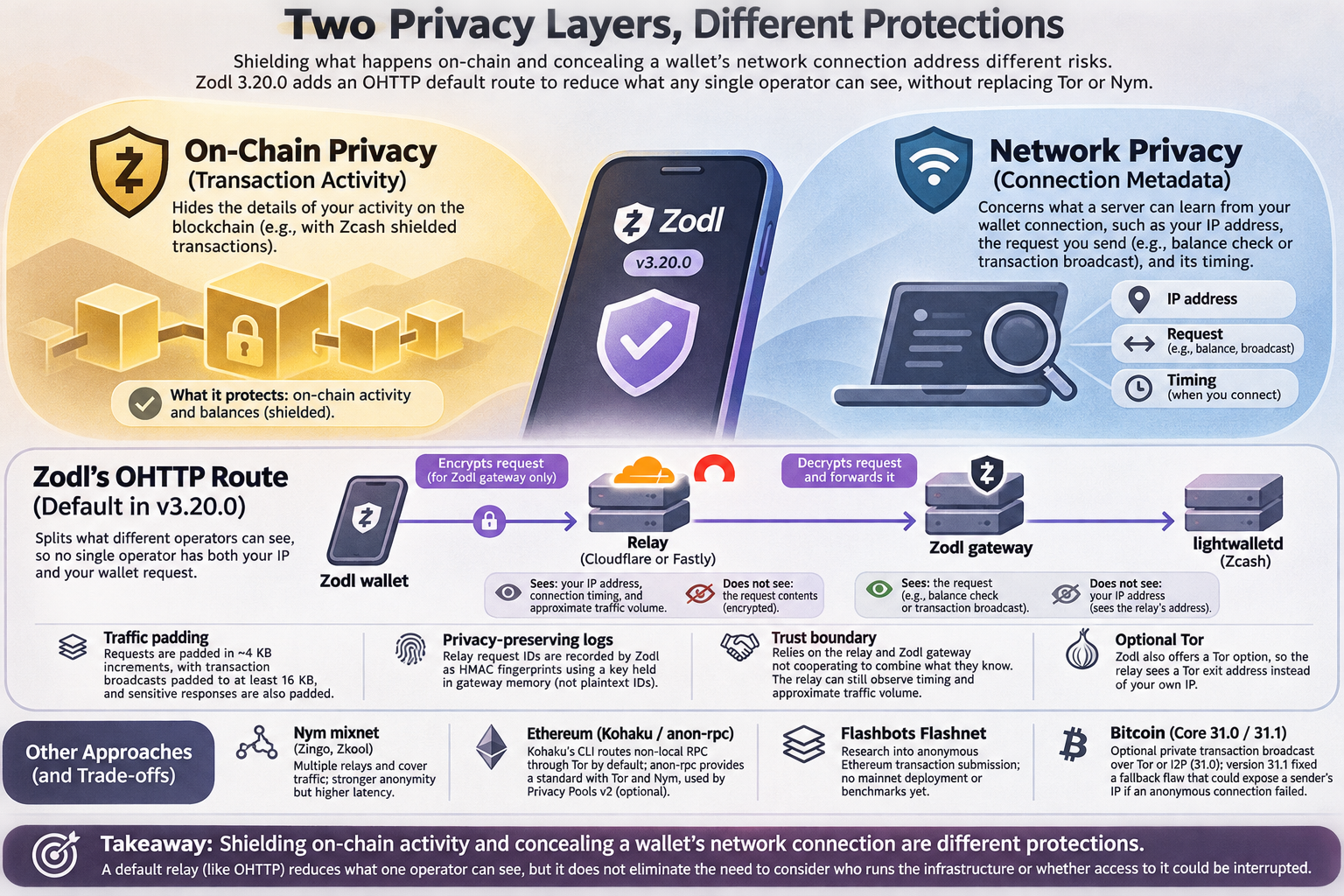
When a light wallet checks a balance or broadcasts a transaction, the server handling that request may see more than the blockchain reveals: the user’s IP address, the request and its timing. For someone holding ZEC long term, that network connection is a separate privacy consideration from whether their coins are shielded on-chain.
In a report published on November 11, 2026, William M. Peaster described Zodl’s rollout of a new default routing system in wallet version 3.20.0. Zodl said the system uses Oblivious HTTP (OHTTP) to keep a user’s IP address and wallet request from reaching the same operator. At the time of the report, the upgrade was being rolled out to users in stages.
What the new route separates
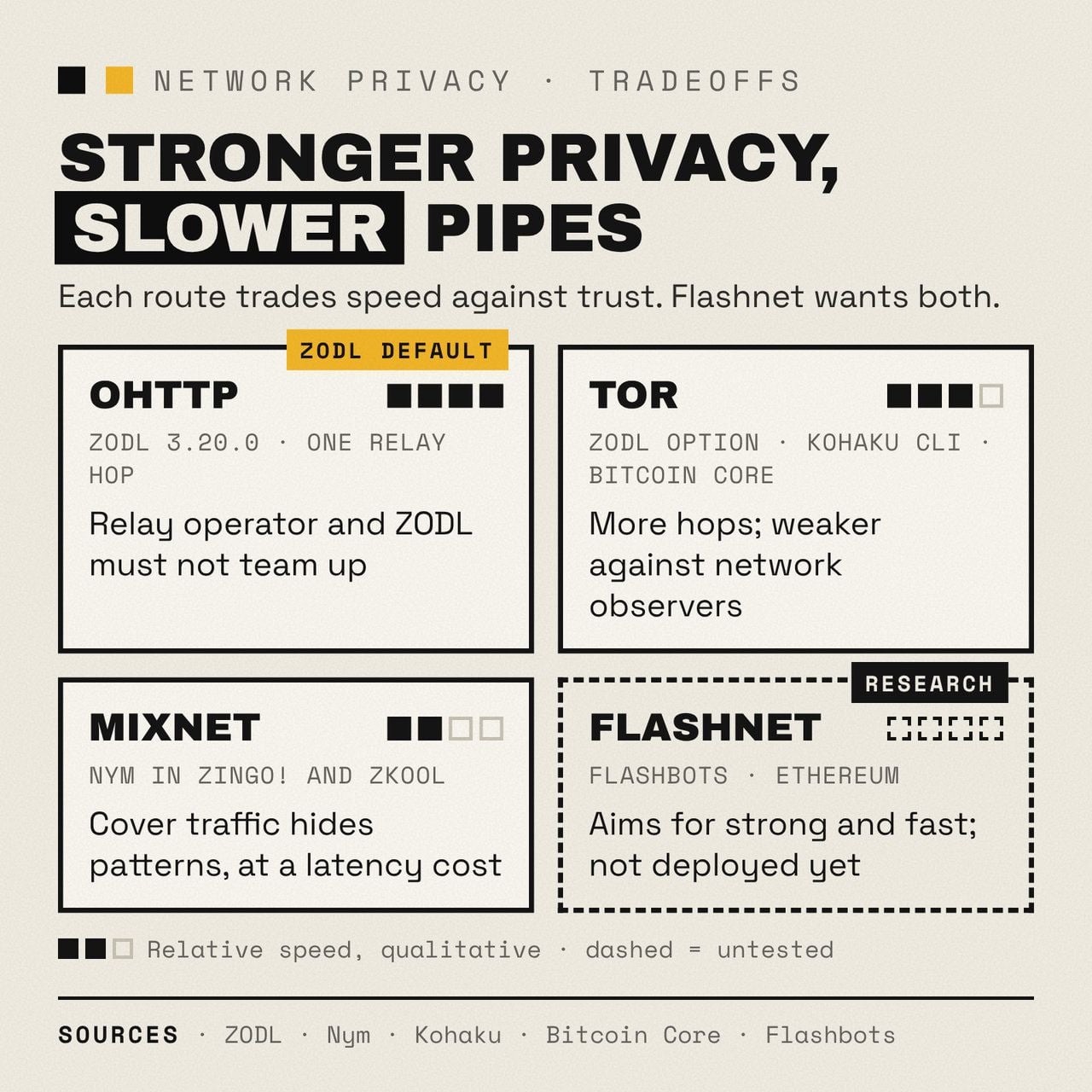
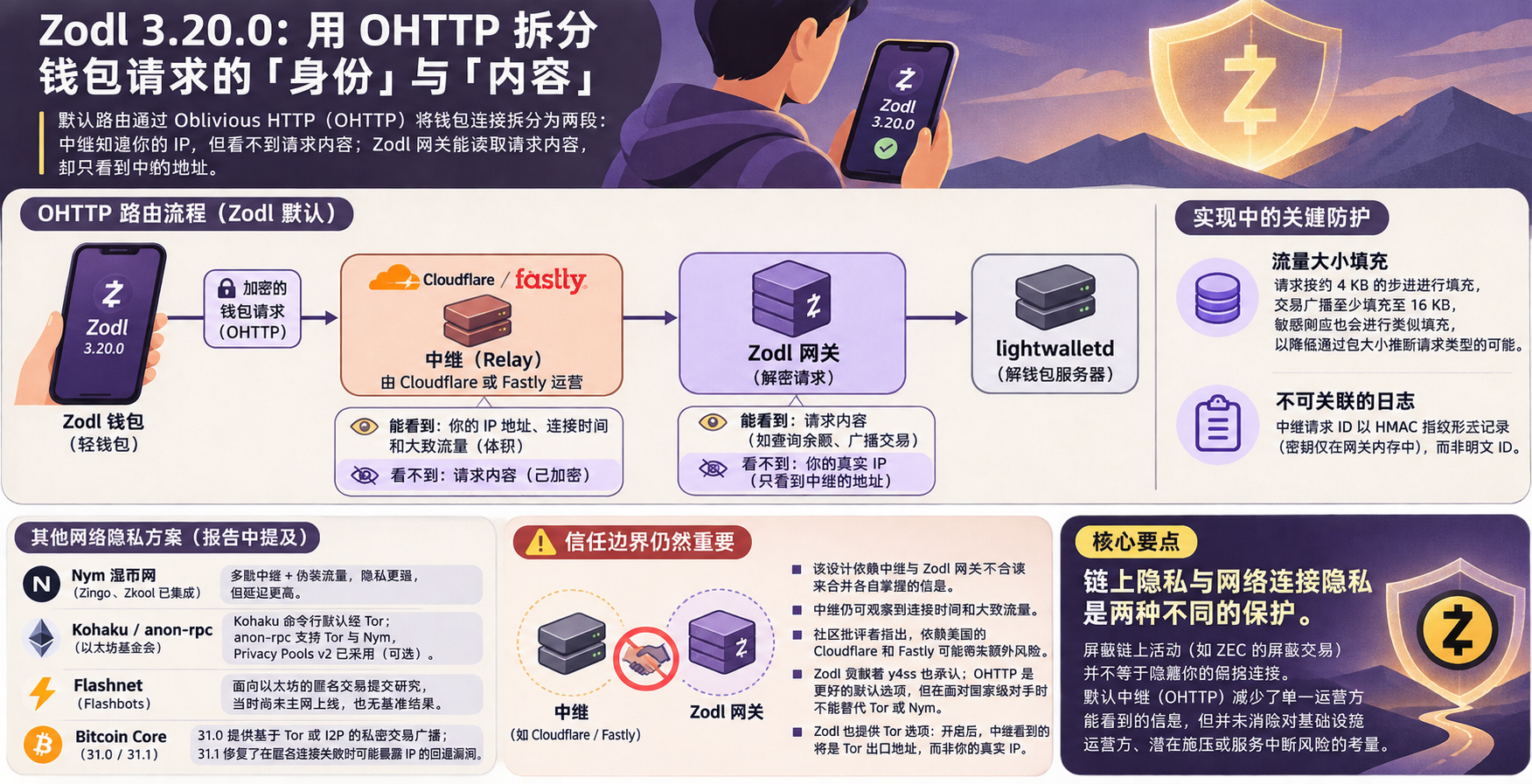
A Zodl wallet encrypts its request so that only the Zodl gateway can open it, then sends it through a relay operated by Cloudflare or Fastly. The relay can see the connecting IP address but not the request’s contents. The Zodl gateway can read the request and pass it to a lightwalletd server, but sees the relay’s address rather than the user’s.
The report says the implementation also pads requests into size ranges—roughly 4 KB increments, with transaction broadcasts padded to at least 16 KB—and similarly pads sensitive responses. This is intended to make request types harder to infer from packet size. It describes a logging measure as well: relay request IDs are recorded by Zodl as HMAC fingerprints using a key held in gateway memory, rather than as plaintext IDs.
The trust boundary still matters
This design depends on the relay and Zodl gateway not cooperating to combine what they know. The relay can still observe connection timing and approximate traffic volume. Critics on a Zcash community forum warned that relying on US-based Cloudflare and Fastly could give users too much confidence in the protection. Zodl contributor y4ss acknowledged the limit, describing OHTTP as a better default—not a replacement for Tor or Nym against a state-level adversary. Zodl users concerned about pressure on the underlying cloud providers can also enable its Tor option, so the relay sees a Tor exit address instead of their own IP.
That distinction is the practical takeaway: shielding on-chain activity and concealing a wallet’s network connection are different protections. A default relay reduces what one operator can see, but it does not eliminate the need to consider who runs the infrastructure or whether access to it could be interrupted.
Other approaches noted in the report
The November 2026 report placed Zodl alongside several efforts with different trade-offs. It said Zingo and Zkool had integrated Nym’s mixnet, which uses multiple relays and cover traffic at the cost of latency. It described Kohaku’s command-line tool as routing traffic other than calls to a self-hosted local RPC through Tor by default. It also distinguished the Ethereum Foundation’s anon-rpc proposal from its then-running Tor and Nym implementation, which Privacy Pools v2 used for an optional connection.
The report characterized Flashbots’ Flashnet as research into anonymous Ethereum transaction submission, with no mainnet deployment or benchmark results at that point. For Bitcoin, it said Core 31.0 offered optional private transaction broadcast over Tor or I2P, while version 31.1 fixed a disclosed fallback flaw that could expose a sender’s IP if an anonymous connection failed.
These methods address related but different risks. For a wallet holder, the manageable question is not whether a privacy label promises complete anonymity, but what a wallet’s default connection reveals—and which additional routing options it actually offers.